If you were unable to attend the MNC Annual Meeting last night, here is a transcript of the talk I gave about my trip to Sweden and the Asarna Ski Camp in August.
SWEDEN 2019
It was 5pm and I was three hours into a mountain bike ride with strange company. When I’m on a bike it usually means I’m either a wheezing asthmatic trying to chase my friend Liam up every climb, or risking my life trying to keep up with my friend Ben on the descents. The last thing I expected on a trip to a Swedish training camp was being dragged through 30 miles of logging trails by 60-year-old ski legend Jan Ottoson and a former Swedish World Cup wax tech.
“Otto”, as he often goes by, has won the 90-kilometer Vasaloppet four times, and at 60 years old he is stocky and maybe not what you’d picture when you imagine a skier today. But evidence of a life in athletics is clear, as he’s built with quads and triceps that I’m sure strike fear into the hearts of Klaebo and Bolshunov alike, and Otto won two Olympic golds before I was even born.
Our other riding partner was Peter, a wax tech who had retired after working with both the Swedish and Canadian Olympic teams. He was the guy that waxed the skis Harvey and Kershaw won the 2011 World Championship on. You could tell he was a tech because he had clearly spent enough years in a World Cup wax cabin to essentially hack up half his internal organs every time we went up a hill.
*Cough cough ohhhh oh, it’s da fluoros, yah* he’d sputter every few miles.
I was in Asarna, Sweden, to take part in a Junior ski camp and soak in as much as I could. Earlier in the week, my Swedish-American guide Hanna had told Otto that I liked mountain biking. On a rollerski one day he brought up the idea of loaning me a bike while the team went to do an afternoon trip to the local go-kart arena. The way I took it, through his broken English, was that he’d lend me a bike and a map and give me an outline of where to go.
But at the lunch table after a 2-hour run around a nearby alpine area, Otto brought Peter over to sit with us as he went over the plan.
“The kids will go to the karting, you can meet me at my house and I will get you a bike and then we will meet Peter. It is a ride maybe to be three hours.” Good thing I’d elected to run with the youngest middle school group in the morning, since it seemed like I’d need my legs.
Outside Otto’s garage I was handed a Trek Top Fuel and, thankfully, a set of padded bike shorts and clipless shoes. A few minutes later Peter rolled up on his bike, coughed and spat into the gravel, and said he was ready.
Thankfully, it turns out a three hour mountain bike ride in Asarna features much different terrain than what we’re used to around here. In three hours biking from Richmond you can easily hit 5,000 vertical feet and traverse several small peaks and valleys. Here, in the deforested hills between Asarna and Klovsjo, we were pedaling at a good clip down what we’d probably call “fire roads” in the US, covering the rolling terrain pretty gracefully.
I was told about the origin of the trail names, the types of cabins we’d occasionally come upon in the woods, and the local Strava segments: each of them featured a back-and-forth on the leaderboard between local hero and Swedish National Team skier Jens Burman, and a professional road biker from Klovsjo named Fredrik.
Mostly, we rode in silence as fatigue set in and the miles hours ticked away. That made it easy to reflect and ponder what brought me here and what I was going to bring back to Vermont.
—–
I’m not a language guy. I hated every minute of French and Spanish in elementary school. When I took Latin in high school my teacher flat-out told me that I wasn’t very skilled at it. But she respected my ability to pick my seat well, since I sat next to a girl named Audrey and was able to simultaneously flirt with her and copy off her work at the same time. I guess I wasn’t as subtle as I thought.
Getting out of my comfort zone with language, even English, doesn’t come naturally to me. When I need to, I can try to give a motivational speech. When I need to, I can try to console individuals or groups to work through problems. I wish it were more of the former and less of the latter, but this isn’t the movies.
I do know this: you can’t develop much of a connection with any skier or any team if you can’t communicate with them. Sometimes it is in that positive way: motivating for a workout or getting pumped up for a race. And sometimes it’s a tough time: working through pain, disagreement, or anger. You can buy equipment and teach technique all you want, but in the ski world AND the real world connecting with people is what really matters.
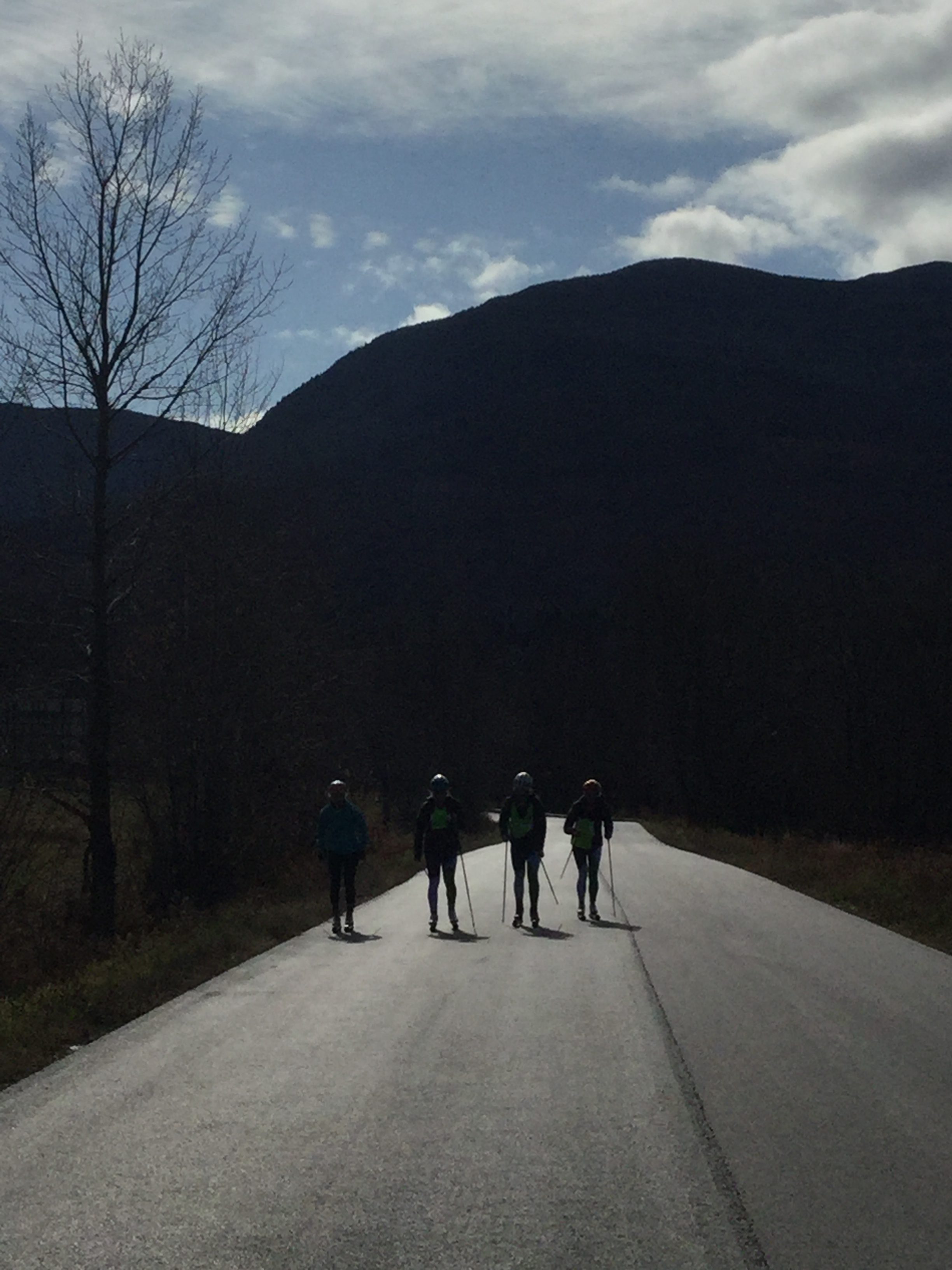
The workouts we did in Sweden were not strange. In fact many of them were less complicated and involved than what we do here at MNC. Instead of progressing through drills or starting with a video to get an idea of some good ski movement, we often began with skis on, were pointed a direction to go in, and off we went for the requisite time.
Even bog-running, the coolest thing besides a ski tunnel that Sweden has and we don’t, was relatively straightforward. Once you got over the feeling of squishing your feet through a Tempur-Pedic mattress with every stride, the run itself involved going out in one direction for an hour and then turning back and returning the way we came.
On workouts like this I’d try my best to work up the courage to start a conversation with some Swedish kids. As you can imagine there were two topics that were brought up to me repeatedly:
“Are you from where Jessie Diggins is from?” and “Do you like Donald Trump?”
I tried to turn the focus to what I knew about Sweden in order to make sure I wasn’t just coming across as an ignorant American. I asked about the geography, where other ski clubs were located, and Swedish athletes from other sports like freestyle skier Jon Olsson. But largely, the workouts didn’t involve a ton of talking by anyone.
That’s pretty different from MNC. I am terrified when a workout is going by silently. Is everyone having enough fun? I fret internally. We can’t even go on a trail run without often bringing along the GoPro and filming ourselves while pretending we are live-vlogging a Survivor-style reality show.
But maybe there’s something to be said for a quiet training session. A very wise parent I know is always telling his precocious young son to “listen twice as much as you talk” which is something I’m trying to do more of. Also, if you thought I’d get through this speech without referencing Matt Whitcomb you were very wrong…after a few American training camps together the thing I’ve noticed Matt do so well is contemplate a phrase or a question he is asked before giving a response or comment. I don’t think this has anything to do with being politically correct despite his US Ski Team status. It’s about making sure the message you share is as meaningful as it can be.
At mealtime, the training camp in Sweden was also very different from our lunches and dinners at Mountain Camp or Thanksgiving Camp. In Asarna campers arrive to a meal, fill their buffet tray, sit down, and chow like they’re already late for the workout that begins in two hours. It’s possible some of the deepest the conversation will get is a question about what the upcoming workout will be or how long it will last. The coaches all gather separately at their own table to quietly converse, barely acknowledging the presence of the skiers at all.
When our Juniors get after it for meals at camp it’s a free-for all of flying cutlery, floor splashes, sizzling pans from stoves left on too long, toasters smoking and burning, and fridge door hinges getting their warranty put to the test. We drag meals on forever, lounging around the table sipping hot chocolate or chocolate milk and arguing over who picked up last time until finally, one of the coaches, usually having just been a part of the fray itself, finally goes “Ok, let’s get to it.”
I spent the week very reserved, often only sheepishly asking for clarification on what a workout was supposed to look like or getting directions so I didn’t end up taking a wrong turn and skiing a hundred unplanned kilometers on Sweden’s vast network of bike and rollerski paths. I felt hollow at times, going to bed feeling like I’d contributed nothing to the group and trying to convince myself to get out of that comfort zone the next day.
During one of the final days of camp the coaches asked if I’d like to lead a workout. Without hesitation I suggested a rollerski agility or cross country cross session. This was an easy choice for two reasons, and a third that I only realized after the fact.
The first reason this was great? It’s distinctly “American”, as Justin Beckwith will proudly tell you. Sure, the first sanctioned XCX race was the Youth Olympic Games in Norway, but this was partly inspired by our agility-loving ways here in the States. This past year there was an international training camp in Norway where representatives from each country were tasked with leading a workout. The Americans, by request of the Scandinavians, used their workout to set up an agility course and speed session.
You can imagine the confidence filling my sails as I pictured myself ready to represent my whole country for this workout. America was on my back, and this was my chance to show what we were made of here in the USA. And that meant how well we could ski over ramps, jump over broomsticks, and ski backwards through the grass…I guess in writing it sounds less heroic.
The second reason this was great? I’d noticed the Asarna did very little agility, which we often bookend every workout with…starting with some slaloms or challenges and ending many practices with a relay as bizarre as it can get…carrying a teammate, jumping through hurdles and ducking under limbo poles…that’s natural for us. It helps the body get in the coordinated and active mindset, making the rest of the workout more effective…or leaving you with some crazy stories after the fact.
The third reason this was great wasn’t planned in advance, but was maybe the most obvious when it happened. Because this type of workout was something I felt comfortable with, and because it required very little discussion and revolved around excitement and a fun-but-strange challenge, I suddenly felt “at home”. I had barely spoken up all week but was now yelling out jumps and hops for the kids to follow in the grass as we warmed up with mobility exercises. I was communicating through my pure energy and excitement for the sport.
It turns out everyone in the camp, with the exception of agility pro Hanna who helped me design the course, approached the workout just like I had approached the whole Swedish experience. Very timid. Afraid of failure and judgement. Hesitating to take chances.
All of that probably sounds very familiar to someone, of any age, just joining a ski club, or skiers in a club preparing for the season ahead. Very timid. Afraid of failure and judgement. Hesitating to take chances. That was, and is, me too.
Thankfully, an excitable agility course shook me out of that attitude in Sweden. Just as the kids in the camp got more and more used to the course, and more and more competitive with each other to keep doing it, I started to feel like I had really made a difference.
I can’t say for sure what helps everyone overcome those fears of taking chances and facing judgement: it’s different for every one of us and it’s what the challenge of coaching is about. Different clubs and different countries have their own workouts and cultures and atmospheres. But if you’re afraid to challenge yourself and afraid to reach out and communicate, you won’t get very far in this sport.
I went to Sweden seeking new ideas and concepts, and I ended up learning some very basic concepts about myself and my own weaknesses. During that camp, I had to go back to being the “new kid” and at times it was terrifying. I had to take a week to work up the courage to communicate, to feel confident, and to ultimately be a leader (if only for a short time).
The challenge is for us all to figure out how to gain more courage, communicate more, and be leaders in our own way when that leadership is called upon.
“