We look forward to collaborating for shoe fitting, training, outdoor events, and more. Some of us may have gotten out for our first running workouts of the spring already, and if you are in need of some new footwear be sure to stop in the store!
You’ll find NBW in the square of Maple Tree Place in Williston. Conveniently, this is a location right near some of our favorite rollerski and running spots like Southridge, Mud Pond, and Catamount.
It’s likely that you’ll find Gary Richter (and canine buddy Augie) helping folks find the perfect fit. Many might know the Richter family from their longtime involvement in the club, including Kai who raced for MNC and MMU before competing for St. Lawrence. Be sure to mention you’re an MNC member when you stop in!
Please take the time to fill out our Winter Program Survey
Social media is ever-present in most of our lives. Never moreso than with a group of teenagers. What do you get when you combine the addictive nature of social media with fitness tracking and athletic competition? Strava.
It’s not hard to find some patterns and archetypes within the Strava-verse. Strava posts can read like a public training log, a witty commentary on regional weather, or humorous self-deprecating takes on one’s fitness. If you’re on the app you’ve likely experienced a wide array of emotions, from FOMO (“Fear of Missing-out”) about a certain workout to the intimidation of FORS (“Fear of running slow”) which is an acronym I just made up about seeing some of the mile splits certain runners are putting up and feeling self-conscious about your own pace.
You may experience awesome emotions like conquering a long workout, or capturing the Course Record on a local segment you’ve been eyeing. These can be both great motivators and dangerous straws to grasp at.
I am not writing this post to create some sort of manifesto on Strava culture. Instead, I think it makes sense to take a critical and somewhat tongue-in-cheek view of how Strava can be a positive influence on young athletes, and how we might also avoid some pitfalls. Therefore I’ve decided to post a list of some “Laws of Strava” that I may reference from time-to-time with our crew. I’ve tried to make these a mix of both positive and cautionary notes. In no particular order:
Law #1) Real races are the “segments” that matter
If segments on Strava were really that important, we’d be doing virtual racing every year and not as a COVID safety measure. A Strava segment is only a record of the fastest times on that segment among people who actually use Strava.
It’s cool that our Bolton hillblimb has a Strava segment, but don’t think for a second that skyrunning power couple Killian Jornet and Emelie Forsberg wouldn’t immediately obliterate any of our top times on that segment if they were to show up. Don’t tie your self-worth as an athlete to achieving records on Strava segments. That being said…
Law #2) Segments are motivators: use them as such
The concept of segments is addicting and often incredibly creative. Almost every uphill or downhill on a road has a segment attached listing times and records. Many trails do, too. If you use Strava regularly, even a boring running loop can take on new excitement if you know where certain segments are. This can really be a motivator on a day when you might not feel like getting out the door.
Law #3) Know your sport, know your speed
Many skiers don’t run cross country in the fall or track in the spring. We know that maintaining a good pace and slowly working into running is a good way to avoid injury and prepare best for a race season next January, not this May.
But there are a lot of folks on Strava with running as their primary sport. They are out in March and April running at 7:30/mi pace and under. There are a lot of cyclists who were out doing 50 mile rides the first day it hit 50 degrees the other week. If that’s not you, it’s ok. Remember there are times to separate your own goals and workouts from those of the athletes you follow on the app.
Law #4) Use Strava to get inspired
I have found trails and routes near my home that I never would’ve known existed without Strava. Seeing where others have been running, riding, and rollerskiing can be really fun and a great way to learn about new places to explore. This past fall, Strava became somewhat of a public forum for people to see and discuss where good early-season snow and skiing was to be found. That’s a great positive element of social media action.
Law #5) Titles and photos
Strava is a lot more interesting when it can be creative. This takes the emphasis off performance at all costs and keeps the “social” in “social media”. When possible, include a photo from your workout. If you have a clever title for a workout, share it! The more everyone works to make Strava fun, funny, and entertaining the less we will all feel stress and pressure from a fitness tracking app.
Law #6) Don’t Strava everything
You’d be surprised (or maybe you wouldn’t be surprised) how much time during a workout you spend thinking about Strava if you know that the workout-in-question will eventually be public. It’s healthy to give yourself a break and go out on a training session with no strings attached other than the satisfaction of a good workout that you completed for yourself and not for the viewing pleasure of your loyal followers.
That’s it for now, but rest assured more Strava laws will definitely be ratified going forward!
Please take the time to fill out our Winter Program Survey
It has been quite a year. 12 months ago Junior Nationals was cancelled mid-event. Our end-of-season MNC Relays were called-off, and spring activities became very isolated affairs.
We’ve made it through a full ski season with COVID among us, and despite so many challenge, lots of great things have happened within our sport both broadly and locally in 2020/2021.
We wanted to solicit YOUR input in sharing some of your “small victories” of the season. This is not just about results: we all have been through a great deal and we hope that many have been able to see and feel and experience some great “victories” in all types of ways.
If you’d like to share a victory, either anonymously or with your name attached, you can check out the form below. We’ll accept submissions for a bit, and then compile into a blog post to share!
We set out with an ambitious goal yesterday. Ski either 100K, or as long as you can. Last year when the virus hit and the end-of-season races were cancelled, the pro skiers of the world took the initiative to use all that fitness and training they’d built-up to tackle big, epic ski days like the one linked here from Hans Christer Holund.
Liquid fuel for the body (sports drink, chocolate milk) and liquid fuel for the skis (Toko spray)
We’ve put a focus on learning about and executing good nutrition and fueling for different types of efforts and training days, so this was another good learning opportunity as well. Whether skiers were going out for 50km, 80km, or 100km the demands on the body were pretty serious. Fueling well can make a big difference, and I’m very proud of how this group took on the challenge.
We left the tent and a table up at Craftsbury from the race the day before, and used it as our “base camp” where everyone contributed snacks and supplies. We had potato chips, bars, candies, liquids, sandwiches, donuts, and much more. A big focus was structuring our fuel intake to coincide with what our bodies needed the most given the combination of consitions, weather, effort, and fatigue.
Carbs were a primary fuel. Fats like potato chips were needed in order to ensure we didn’t begin to pull from fat at the cellular level after carbohydrate stores may have been drained. Sodium was key in the heat and sun, and sugars and caffeine were the final boost to make it through the final couple kilometers. The team all asked really good questions regarding “what should we eat now?” along the way. At the end, even those who completed a full 100K (Ava, Quincy, Rose, Rye, and a very dead Coach Adam) didn’t wind up with any of that crazy post-workout food delirium crazing burgers or pancakes…in fact, we stopped for pizza on the way home and couldn’t even finish two pies among us! I think that speaks to the amount of fuel we deliberately consumed during the ski, even if we weren’t feeling hungry at times.
Some of the crew ready to begin. We started early and got fast snow for 30km before it all turned to slush
But beyond just the fuel aspects…it takes a whole lot of drive and fitness to ski 50+ kilometers. I am so impressed with everyone who gave this a go, and it was especially cool to be joined along the way at times by various friends. The Craftsbury grooming staff, whose building our tent was adjacent to, were happy to pop out and check on us whenever we stopped for snacks, intrigued by our endeavor. Thanks to THEM for keeping the trails in such awesome shape this late in the season and in this warm weather!
We had 30k of awesome fast skiing, which felt like nothing. Free speed from fast icy corn snow…fast enough that a few skiers flew off the trail into a ditch at the bottom of Elinor’s! However the sun was relentless and soon enough the trails began to turn soft.
“Oh god, it’s happening!” was a cry that spread among the ranks at around 35k into the ski.
It wasn’t long before we were using some extra shin muscle to slap our skis together as we continually tried to smack off the buildup of slush on the tops of our skis. We barely made it around Sam’s Run twice in the morning, but knew that after an hour or so of hot sun the trails would require too much portaging of skis. We found Ruthie’s to be the best bang for our buck…the climb stayed in the shade all day which meant it was firm, and the runout/flat back toward the center was like a couple of free kilometers.
We were prepared for the slush somewhat…everyone brought multiple pairs of skis, so we continued to switch to fresh boards as the snow got wetter, much like the World Championship 30km and 50km races. We also had lots of Toko yellow spray glidewax that was re-applied as much as possible. Those of us with white base skis saved them for the last 25km and let me just say that personally they were a lifesaver.
Mentally and physically, things got difficult for different skiers at different points. What was most impressive was how positive the attitude stayed. Near the end, it felt like I was being the negative one and was brought back to reality by this awesome group of skiers. I don’t think a coach could ask for more than that! In the end myself and four of the gang (Ava, Quincy, Rose, Rye) completed 100km. Emma hit over 80, and Virginia, Sam, Hanna, Isabelle, and Rick skied over 50. I don’t even think I’d call it “Type 2 fun” except for maybe the last 5 kilometers…
For many, the racing season has ended with the exception of the FIS race this coming weekend at Craftsbury. Now what? Is it time to lace up the running shoes and start accumulating mileage? Time to circle the track in pursuit of a PR this spring season? Time to hit the gym and pump iron?
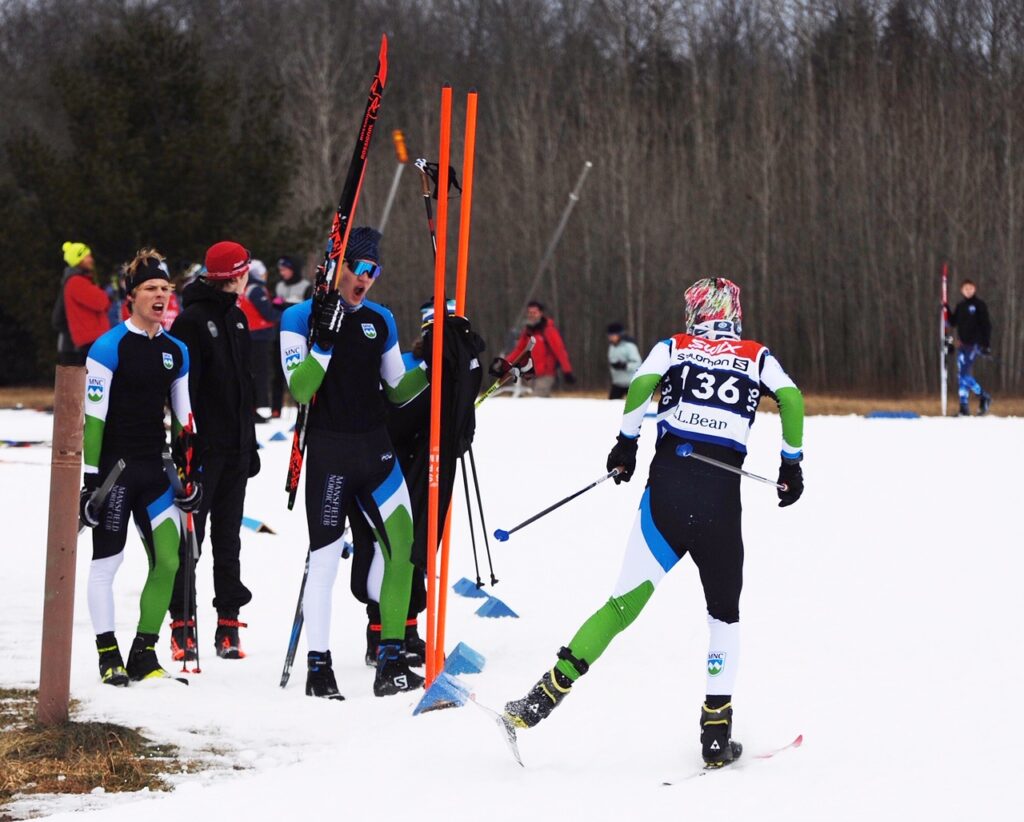
When it comes to physiologically ending one season (skiing on snow) and preparing for the next (dryland) we need to be careful and thoughtful. We’ve been training on snow for months now, meaning we’re only used to one medium for activity: skiing (and strength training for some).
During the dryland season we have rollerskiing, biking, hiking, and running to contend with. If we immediately jump into those other activities full-force our bodies are just not going to handle them well.
Ending one season also means transitioning out of competition and into a building phase. For those competing in spring endurance sports, this season is the hardest because there really is no building or rest phase: you go right from pushing yourself in one sport to pushing in another. This works ok with fall sports like cross country because additional rollerskiing and volume can be added, and racing in the fall is a great way to tune-up for ski season. But in the spring we are looking for a different stimulus. When the skis are first hung up, it’s time to be careful about when and how you go hard.
We work through our training logs in weeks and months, so it helps to use the calendar as a baseline. April is considered to be the skiing “rest” month. In this rest month we are still training, although it’s all about slowly getting used to those dryland activities (more on that below). What happens when the ski season ends and we’re only halfway through March?
We still have snow to ski on, at least this week, and hopefully a bit into next week. If we have the means and the motivation, we want to extend the on-snow skiing as long as we can! At first this means seeking out groomed trails for Nordic skiing, and continuing to incorporate a mix of intervals, distance skiing, and even maybe hard efforts like timetrials. In the springtime we try to keep these fun though, such as intervals that end at Bryant Cabin so that we can come back down through the backcountry.
Once Nordic areas lose their groomed snow, it’s likely that you’ll still be able to find snow higher in the mountains. That’s when it’s time to do some backcountry exploring or even “nor-pine” skiing.
Once we’re in nor-pine season, it usually means incorporating running 2-3 times per week on non-ski days. This year there’s been some interest in a weekend running group to gradually build up some miles. When running, whether solo or with our group, it’ll be important to:
Start slow (even paces that might feel arduous…your legs have NOT done this in a while!)
Incorporate warmup drills and running technique progressions
Bring out bands for hip strengthening in order to prevent injury and strengthen our strides
When the snow really is all gone, we’re looking at April, and the chance for rest. Good skiing is likely to have ended, and rain and mud come out in force. Since we continued to train through March, the rest is earned for this month and there’s no shame in sitting inside on a rainy, gross day rather than forcing yourself to motivate for a run or bike ride.
In April and May, it’s time to build back. Running, biking, rollerskiing, and strength are the main summer modes of training. Here’s a very generalized idea of how to incorporate them slowly:
Running
Start with 2 or 3 miles at a very easy pace, every other day. Gradually increase the distance of your runs first (no more than 10-15% increase in total mileage each week, which will feel small but adds up!). Incorporate band work whenever possible. Every run if you can!
Biking
Mountain bike trails are often too wet and muddy in the spring to ride. You can still get your MTB legs ready with some gravel riding, even if you don’t have a “gravel bike”. Pick some dirt roads, remember hi-viz clothing, and explore. Biking is the best way to do some longer spring workouts because it is not weight-bearing and has less injury risk.
Strength
In later April and May we really want to be getting into some functional, traditional strength training. However in the spring we can still get ready with a little bodyweight action. Focus mainly on the core, the upper back, and the hips. The MNC band warmup above serves as a good addition to any strength routine. And although it may bring back some Spring 2020 quarantine PTSD…you can find a basic solo strength workout video below.
Rollerskiing
This is saved for last because in April it is the least-important! We often start rollerskiing in the very end of April, but not much before that. Many of our strength exercises keep the ski muscles engaged, and taking a break from the repetitive motion of skiing can actually be good. It allows us to work on technique areas by coming into the movements fresh, and the break also serves us well to get motivation up for a LONG stretch of rollerskiing. Breaking out the rollerskis isn’t recommended more than once per week in April.




 edium for activity: skiing (and strength training for some).