Author Archive | Adam Terko

Training COVID-19 Update (4/27)

Happy first day of the training year MNC!

With the “training year” beginning with the week that contains May 1, we are officially on our way into the 2020/2021 season. Given the Coronavirus, this ski season is certainly off to an auspicious start, but that doesn’t mean we will let it hinder us as we prepare for another great year.

There are a lot of questions floating around…

  • When can we start training together again?
  • When does “Spring” training start, and what about “Summer” training? What’s the difference in today’s world?
  • Are we still going to have Mountain Camp and Mini Mountain Camp?

To answer these in the most concrete way possible (at the moment), here are some updates.

When can we start training together again?

This is both easy and difficult to answer at the same time. Until we get a directive from Vermont and Governor Scott, we will continue to maintain more of a “virtual” model with Junior training suggestions posted online. During this time we encourage everyone to remain vigilant with good social-distancing…it will make training

as a group again that much more rewarding and motivating!

As of this writing (4/27/20) Vermont is doing very well at containing the virus and meeting or exceeding benchmarks for the gradual re-opening of the economy and loosening of social restrictions. We are fortunate to participate in an outdoor sport, which means we are more likely to have early-access to gatherings…athletics that are gym- or indoor-based may not be so lucky.

Regardless, when we begin training again we can predict a few changes both in the form of government oversight as well as our own club’s efforts to remain safe.

  1. It’s likely group size will be limited. Be prepared for multiple training options per day, with a sign-up sheet of sorts to help make sure we are not gathering as too large of a group at one time.
  2. Expect to operate sans-MNC Van for a bit, as putting so many people in a confined space is risky. With the lease still ongoing, we want to be able to utilize this resource as much as anybody else, but safety comes first.
  3. At training, be prepared for coaches to expect good habits: maintaining distance, courtesy on any roads, trails, or paths we may be training on, and likely face coverings (buffs, if not more) during training sessions. Bright clothing and helmets are no longer the only pieces of safety to remember at training this spring and summer.

When does “Spring” training start, and what about “Summer” training?

With schools moving to online models and no spring sports seasons, we find ourselves in a unique situation. In some ways we have never had fewer conflicts to prevent the kind of ski training that’s best for April and May…and at the same time we’ve never had a bigger conflict than the virus.

The likely course of action is to open signups once we are confident of a starting date, with the “end” date still coinciding with the start of “Summer” programming the third week of June. This keeps continuity in our pricing/timeframe/scheduling for summer training.

Are we still going to have Mountain Camp and Mini Mountain Camp?

Given their start-dates in July, both Mountain Camps are still “on” for the time being. Our lodging reservations can be held until June 6th before cancellation would need to be decided upon. As we get closer to that date, we will continue to evaluate the safety and feasibility of holding the camps in their traditional NH location.

Crossing state lines, particularly with a group, may be prohibited or at the very least an unwise decision. That leaves Mountain Camp and Mini Mountain Camp with 4 possible scenarios:

Scenario 1) Mountain Camps continue as usual, in NH

Scenario 2) Mountain Camps are altered to take place in VT, with potential locations in either Southern or Northern areas of the state

Scenario 3) Mountain Camps are adjusted to take place later in the summer/early fall, depending on COVID-19 progression

Scenario 4) Mountain Caps are cancelled

What can we do right now?

As of today (4/27/20) it is recommended that we continue to follow distancing guidelines. The MNC community has been incredible in its response to this virus, from motivating and getting out the door to train and share their activities online rather than in-person, to the willingness to participate in video challenges, virtual meetings, and other ever-present new methods of community engagement in today’s current environment.

Remember, the end of this weeks marks the Quarantine Uphill Challenge, now picked-up as a NENSA event!


Quarantine Uphill Challenge: Now a NENSA event!

Now a NENSA event!

With the running season starting in earnest for many of us, it’s time to collectively rally toward a goal. We may not be able to gather in person, but Virtual Races 

have become a way for athletes to stick to some familiar territory (the competitive side) regardless of the social distance between them. 

For the ultimate in socially-distant masochism, look no further than the recently-completed Quarantine Backyard Ultra, won by Mike Wardian after running 262.5 miles worth of 4-mile loops in his neighborhood.

Our new challenge for Spring 2020 is not quite as epic in terms of length…but you WILL notice that the quarantine ultramarathon race came down to 2 competitors, one on a treadmill and the other (Wardian) running on a flat loop in Arlington, VA. What’s lacking here? That’s right, some UPHILL!

Our MNC training year often starts off with a grueling workout: the Bolton Uphill Run Test. We use this test to gauge fitness several times in the year…often once in the spring, twice in the summer, and once or twice in the fall. It’s not unheard of for the first test of the year (May) to involve scrambling over some un-melted snow, just as we’re equally likely to have snow falling on our heads during the final test of the year in October or November. We keep a long-running archive of tests to track fitness.

In this time of COVID-19, we are putting the challenge out there for New England skiers to run their own uphill test to kick-off May. Much like NENSA’s Club Cup and Zak Cup, this is a challenge for everyone! You’ll find the rules to be quite forgiving when it comes to the “uphill” requirements. Read more below:

What: MNC Quarantine Uphill Run Challenge 

When: May 1st, 2nd, or 3rd (Fri/Sat/Sun)

Rules: Run your own uphill test, on foot, as fast as you can. The requirements for this test? 

-Race must finish higher than it started: a net elevation gain. No minimum or maximum on the elevation gained…it can even finish just going up your driveway if that’s higher than the surrounding road!

-Race has to be on foot…no faster means of transportation like a bike, or even rollerskis..! 

-Race cannot take place on closed trail systems such as the Long Trail or local MTB networks. Please respect the closures from our trail stewards, and focus on roads (paved or dirt). 

-Use the form below to submit your race data, including (optional) Strava or other fitness-tracker details as well as photos. We will have awards for all sorts of catagories including most elevation gained, fastest 2-mile course, most creative route, and best race photo (can be staged).  

Results Submission Form

Submissions due by Monday, May 4th. Time to start planning your ultimate uphill test!


Heart Rate Training

With a long stretch of training ahead, now is a good time to take steps to improve your daily work and sessions. A lot of us skiers know that there is benefit from taking it easy on some days, and working hard on others. Sometimes, easy work done for a long enough time provides good benefit…other days, hard work in a short session is the call.

How can you measure these workouts and be sure you are doing the right thing, at the right time? One of the best measurements is your heart rate, which can guide everything from your workouts themselves to the recovery you’re getting when you AREN’T on your feet.

Heart rate monitors vary from the inexpensive and simple to state-of-the-art computers packed with power right on your wrist. But you don’t need to spend hundreds to get a lot of benefit. There are plenty of interesting articles out there to guide training and learning…I’ll link two relevant ones below:

Light reading: Fasterskier article (summer 2019)

Dense reading: Marit Bjoergen’s training history (scholarly article)

How do we utilize Heart Rate monitors with the club? We generally group training into 5 different “zones” or “level”, the most common way for skiers to simplify this stuff. I’ll list the theoretical percentages of max HR (more on how to determine that later) as well as examples of what that pace looks like among our Juniors.

“Norwegian” Level 1, 50-60% of max HR: Generally the pace we use on a very relaxed recovery day or session, such as an afternoon jog at training camp after a morning that included a hard workout. Any uphill is walked. Termed this because of tales from an international training camp where “on easy day’s the Norwegians shuffled along and went super slow, but on the interval days they kicked everyone’s a@$.”

Level 1 60% of Max HR: Easy pace training, some hills may be walked on steep trails (such as the singletrack at Cochran’s) while other gradual hills like those you may find on dirt roads would still be in a run. I like to have this 60% be the average for the workout, meaning in some cases you would be above level 1, especially on rollerskis and ESPECIALLY on classic skis where it’s important to go quick enough to maintain good technique.

Level 2 75% of Max HR: Best way to describe this is either when you are feeling a bit “in the zone” on an L1 day and pick things up naturally, or when people begin to jockey for position and show some edge or advantage in what should be an easy workout. Funny enough this always seems
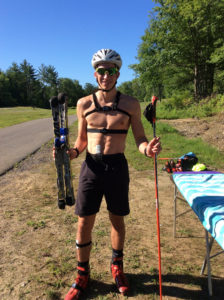
Skiing science subject Will Solow

to occur at REG camp and NEG camp where athletes from opposing clubs end up training together…who would’ve thought? At MNC practices this will usually lead to someone either yelling “Pace-Police!” to encourage a slowdown, or simply going to the front and slowing the pace oneself (therefore literally becoming the Pace-Police Officer)

Level 3 80-90% of Max HR: Best suited to longer intervals on terrain that is gradual. One of our keystone workouts in the summer is Road 101 in Smuggler’s Notch. The interval itself is about 20 minutes in length, with the last 4-5 minutes being steep enough to become L4. However, the road starts with long gradual sections that can be skied with good control. This is the type of workout, whether running or skiing or biking, where you feel like a “hero” because your technique can hold together. However you are on or just below the Anaerobic Threshold where your body starts to rely on stored sugar and lactic acid begins to be produced faster than your body can remove it naturally…inte

rvals and work of this type helps you can a lot of efficiency by training your body to handle greater and greater levels of effort and oxygen consumption.

Level 4 90-95% of Max HR: An effort of hard work that can range from 2-15 minutes in length, sometimes shorter. If you have ever competed in a 5km race, much of that time will be at level 4 with the exception of descents and (if you are on skis) flat and fast terrain. Quintessential L4 workouts are 4-5×4 minutes uphill running, or 6-8×2 minutes rollerskiing. We are also a bit fan of 30/30 workouts (30 seconds on, 30 seconds off) at Level 4, where your body gradually loses the ability to clear the lactic acid produced within the allotted 30 second recovery window. This type of training helps top speed, efficiency, mental strength, and pacing.

Level 5 95-100% of Max HR: Pretty tough to sustain…this is reserved for sprints and speeds! Think the final 100m or a race, or alternatively a 200m effort on a track. This helps work on speed-of-movement and fast-twitch recruitment. Also, head-to-head this type of effort is usually very fun!

How do I know my max HR?

There are a lot of tests out there, as well as simple rules like “220 minus your age” which has been around for a long time. In our world, without access to serious testing facilities and oxygen-uptake measurements, there are a few ways I’d suggest going about this:

  • Uphill run test. Luckily we have an option for one coming right up! However this can be done whenever you choose. Ideally this will be a test of most (if not all) uphill terrain for 11-18 minutes. In some cases going longer than this means your body will pace naturally into a more controlled effort. However, it’s highly likely that sometime during an uphill run test you will be at least within a few ticks of your max HR. If your monitor tells you your “max” for that workout (most all should) use this info!
  • 2min repeats. Alternative to an uphill run test, 2 minute hard intervals up a hill are great. Recovery time is just the trip back down, and using poles will both be more ski specific AND create more effort from the whole body than running alone.
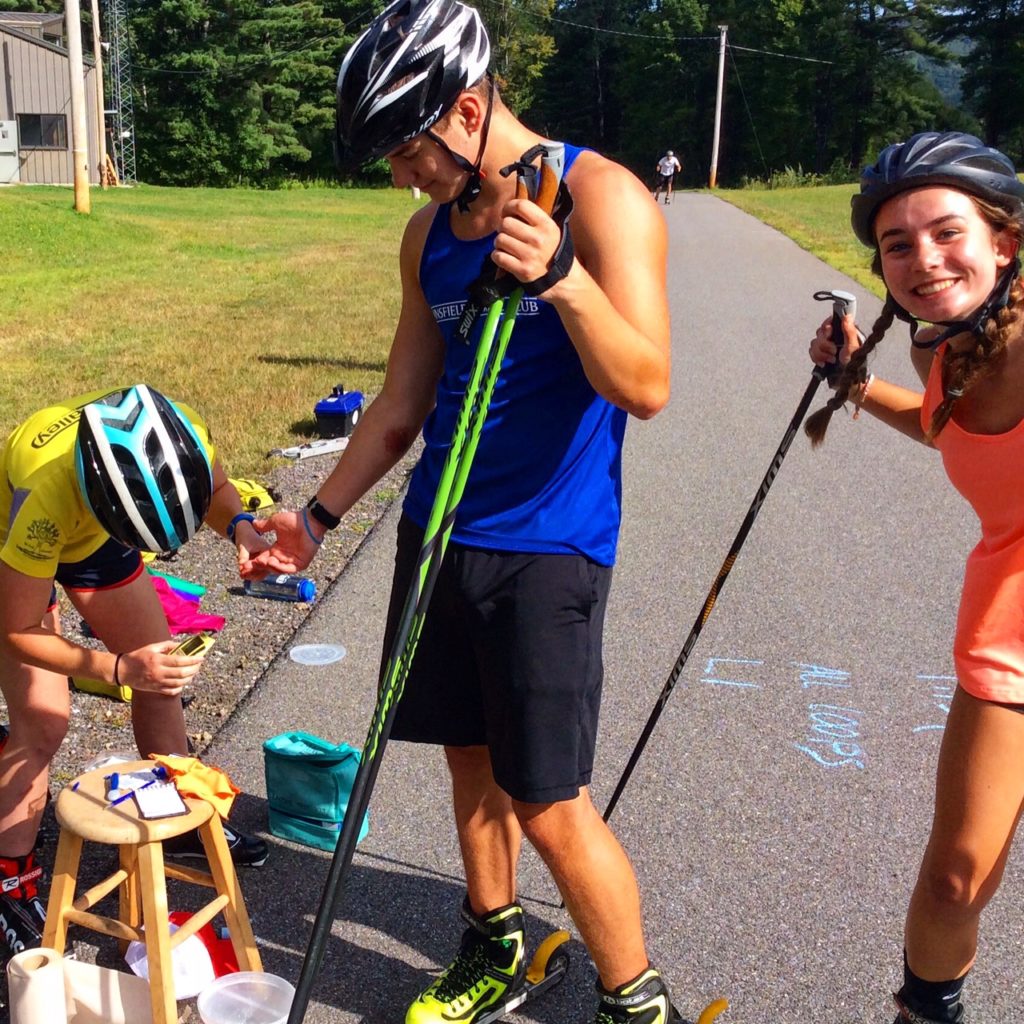
Lactate testing: another way to measure effort and the subject for next time!

Michael G’s Quarantine Vignettes

A nice collection of selected reading material, including tales and analysis relevant to MNC Masters, compiled and written by Michael G. 

Inspiration Station

The last month has felt like a CVS checkout line (remember those?) come to life as we must simply, wait. There are great many things to be anxious about in this current moment but it is most fun to focus on the least meaningful of these in order to distract from the most meaningful.

In my case, it’s the fact that I didn’t get that one last chance to race with friends and prove myself before saying goodbye to the season. I’m sure skiers at every level feel this pain but for a master skier it’s all the more acute given the inevitability of your physiological decline. Last year, quite literally, is never coming back and I’ll be one more year away from my lifetime max heart rate next year. 

For this reason, the off-season for masters is an extended effort to walk up an escalator—a prospect made more challenging by having fewer people around to share in the ludicrousness of the exercise.

The good news is that there is lots of good news about aging and athletic performance despite this Sisyphean task. I like to collect articles or interesting pieces of information on this subject to pull out at times like this for a dose of optimism. 

Below are a few of the more interesting pieces I’ve seen recently. Note that the only kind of peer review I understand is when I’m late for a carpool, so my science literacy is lacking. What I’m really looking for is inspiration in these articles and enough credibility for me to share with the MNC’ers in the health care world (thank you!).

Data to Consider on the Erg

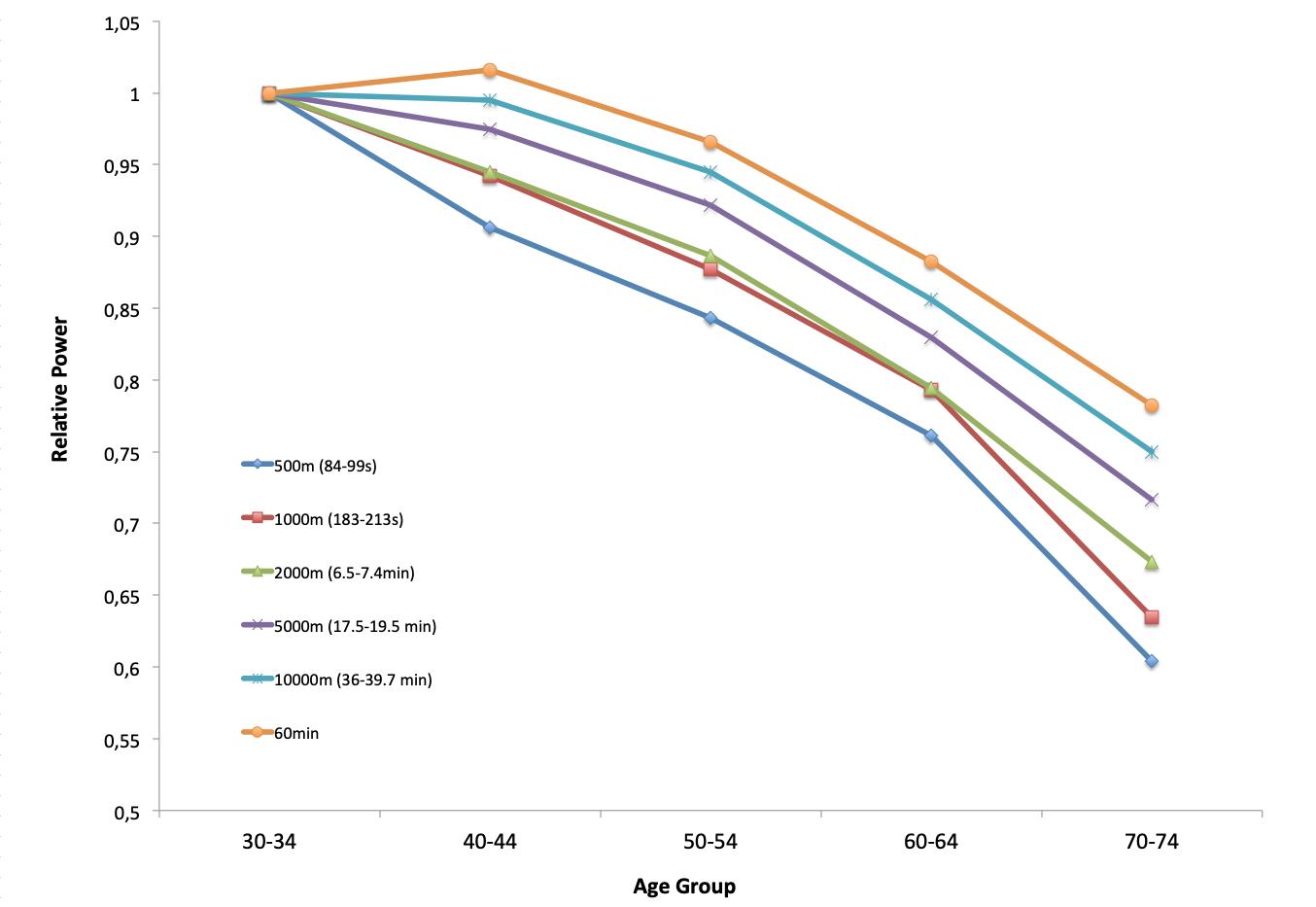
Stephen Seiler basically wrote the book on the 80/20 training methodology (actually someone else wrote the book and took credit) and is an American professor of sport science working in Norway. He has an active Twitter and analyzed 20 years of Concept 2 data in a recent post. The results indicated good news for masters. The data, shown below, shows that age classified performance for longer distances decreased much less than for shorter distances. No bias here but I was particularly encouraged that for M3s at distances of 10k and above the data indicated increased performance versus M1s. 

Image

Image


Run like a Dad

Alex Hutchinson has a regular series in Outside that examines recent developments in sports science. He recently examined the physiological profile of older elite marathoners. Superficially the article is great because it discusses several runners up to the age of 70 breaking the 3 hour marathon. The take away is more important; however, which is the ability of masters athletes to have extended performances at very high levels of VO2 max. Consistent with the Seiler data, it shows that masters both have heart and can crush for a very long race. In other words, despite the fact your engine isn’t the newest model you can redline it much longer than when you pulled it out of the lot. Of course, this does mean keeping that VO2 max high, so be sure to heed Adam’s challenge and make use of this down time!

MNC Masters

There’s no scientific research on the benefits of being an MNC master skier but none is really needed. Like myself, there’s a common thread among masters that are crazy enough to drive two hours for a 30 minute race, which is that we’re either new to Nordic or rediscovering after years away. In both cases, the drive to make up 

for lost time is what gets most of us out to the Range and certainly, oblivious to eye-rolls from Kort’s neighbors when attacking the Southridge rollerski course.

Alongside the lost time is ample opportunity to improve technique, which in a lot of cases is way more helpful than cranking out interval sessions. For this reason, a technique heavy sport like Nordic skiing is perfect for an aging athlete because it allows a backdoor for performance improvement even if the only wheels that your going to spent 300 hours on top of are those of your desk chair. 

Hopefully, these articles give you enough reason to make it through the next couple months when the promise of warm days outside makes the training easier and the memory of last season more distant. See you out there from afar!


Rollerski season is upon us

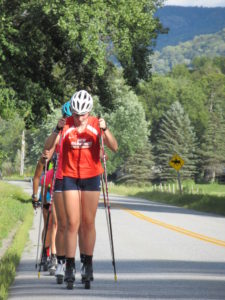
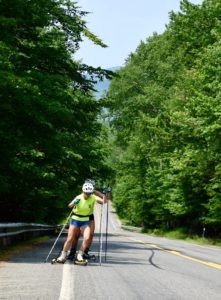
Although we may all have personal preferences of when to start rollerskiing (all the way from “I can’t wait to get on the rollers this spring” to “Don’t expect me to ever touch those things”) it is generally accepted that for training purposes, the start of rollerskiing coincides with the start of the “training year” on May 1…or in this case, April 27th in terms of how the calendar dates fall.

Due to the fact that we…

a) lost a chunk of end-of-season racing and regular training and

b) have been restricted in our training by remaining socially-distant and keeping off trails

…I am proposing we unofficially begin the rollerski season a week early.

During a switch of seasons, it’s natural to feel a bit awkward while also noticing some soreness in areas that may not present in one sport or another. How many of us began the running season and had to keep it slow and short at the beginning to ease into the new motions and stresses on the body? The same should go for rollerskiing.

This off-season is where we make a lot of technique progress. This progress most often happens through good repetition and habits…as the US Ski Team coaches are fond of saying, “practice doesn’t make perfect: practice makes permanent”. It we go out and do a long ski before we are ready, we might fall into troublesome movement patterns or not have the strength yet to perform motions with good energy. All of a sudden, we are making weak movements permanent by staying out too long and drilling them into our bodies.

Keep it short and steady, increasing week-by-week. Just like a runner builds up mileage to prevent overuse injuries, rollerskiing should be at least somewhat structured in terms of volume. Starting in the 30-50 minute range for the first 2-3 rollerskis is a great way to ease back into the motions. If you feel like that workout is “not long enough”, you could rollerski for the first part and then switch to running or biking for a bit after the ski. But do not be tempted to go out and treat things like you left off with your last long ski at Craftsbury or Trapps.

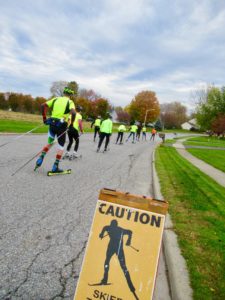
Stay safe and be seen. While quarantine has made things a bit less crowded on the roads, that’s no excuse not to wear hi-viz clothing while rollerskiing. Unless you are exclusively on a bike path (and even then it might be helpful for others) please wear reflective clothing or, at the very least, a yellow or orange shirt. I don’t think anyone in our club needs to be reminded to wear a helmet during a rollerski, but I’ll put that here anyway…

Drills are your friend, and your poles are not. Unless you have been really working your upper-body during the month of April (bonus points if you have!) you are likely going to get a bit tired in that area first and foremost. In order to gradually build up that tolerance, while also getting in some great balance and technique work, I recommend starting EVERY skate rollerski with 10-15 minutes of no-pole skiing. Not only does this keep you from over-cooking it right off the bat, it also helps the body learn and re-learn good movement quickly by isolating one part of the ski motion. Check out this somewhat-dated but still-relevant MNC video showing several rollerski drills you can do on your own. Another unintended benefit of quarantine? There are a lot of empty parking lots out there!

For those of us with classic rollerskis, it is never too early to work on double poling, though I might suggest keeping those DP-specific sessions even shorter than a skate session because this is the technique where it can be very easy, especially in the early-season, to break down in the core, hip, and upper-body areas. A progression of drills the Juniors have done for years is what we call the “activation drill”. I would be a wealthy coach if I had a nickel for every lap of Stadium Loop at the Range that has been done by the Juniors as a part of this “activation drill”…it is basically the way we will begin most every rollerski practice, as it is worthwhile both for double pole and V2 technique.

Rollerskiing also comes down to the equipment itself. Make sure your gear is ready to rock! Just like you would check your bike tires before a ride, make sure all nuts and bolts are tightened. I’m a big fan of using Loc-Tite or any other brand of thread-locking fluid which is a few bucks at most hardware stores. It’s a 10-minute task to loosen the nuts holding your wheels on, putting a little Loc-Tite on them, and re-tightening.

Sharp pole tips are pretty useful…you can buy new ones when they get dull, OR you can use a diamond-file to keep them sharp and get a LOT of use out of just one pair!

  • You can get ones from Swix or other tuning brands which are technically made for alpine ski edges. These are sold at Skirack in the alpine tuning section on the lower floor near the bike service desk.
  • You can purchase tool-sharpening diamond files from hardware stores (this yellow Smith one is the model I have, and I like it because it’s a bit larger AND yellow, which means I’m less-likely to lose it or leave it somewhere on the side of the road or trail).

If you have composite rollerskis (made of a mix of materials and cap construction) like Marwe 620 or Swenor Fibreglass, check the wear on the materials. When using these types of skis try as best you can to keep them clean or at least wiped-off if you’re skiing through terrain that’s got dirt, sand, salt, etc…

Lastly: remember that MNC members get 30% off Swenor rollerskis at www.enjoywinter.com with the code “MNC1920” at checkout! Swenor skis can also be found at Skirack right in downtown Burlington! Other good sources for rollerskis at reasonable prices:

RollerskiShop.com/Pursuit Rollerskis

Pioneer Midwest/Hjul Rollerskis

Got skis? App Gap 2019 by Pennie Rand

Social media & sharing icons powered by UltimatelySocial