Archive | Junior Blog

XC Running and Skiing Notes

Runners!

Some thoughts on XC running and XC skiing. We are at that time of year again where running is starting up in force and the training might look a bit different than what we’ve been up to at MNC sessions. I wanted to share a couple thoughts and things to keep in mind.
I’m also linking this article from Andy Newell that I believe I shared with some runners last year. I wish this article went a little more in depth on a few topics, which is maybe why I’m feeling compelled to write this post.
I’ll try to break it out in bullet points so this is easier to to digest:
1) Base and peaking
I remember the very first time I was taught this it came from Kasie Enman at a CVU Nordic team pre-season meeting in one of those basement classrooms that may or may not still exist.
Her analogy was simple: picture your year like a triangle or a pyramid. The base of the pyramid is wide, and the blocks are big and more square. That’s the L1 and distance training we do all summer: the base that helps us be able to handle all the hard stuff later.
As the season goes on and we get closer to big races, we get higher on the pyramid. The total time drops, and many of the workouts are harder. The blocks are smaller and they’re more pointy…of course, the very top of the pyramid is the sharpest part! That’s the last Eastern Cup/States/Junior Nationals/etc.
The hardest part about XC season is that you get to school and you have a very limited time before the races. In the month of September, you’re suddenly very high up and on the narrow, pointy part of the pyramid even if you may not have climbed up there yet with training…our ski training is all based off being at that top part in February and March, so while we have done 3kms and running workouts, we haven’t done the hardest and sharpest blocks yet. It’s important to make sure we are still incorporating workouts where we have a higher total training load, particularly of easy distance. It’s also important to maintain our ski-specific strength. I’ll go into both of these now.
2) Pacing, racing, volume
We made a concerted effort to work on run pacing this spring and summer. The downside was that many of these workouts were pretty sparsely-attended, as it’s most easy to do a running workout on-your-own. The goal of paying attention to pace was to gradually build into running by taking miles a bit faster than we usually do to both increase efficiency and to be able to run harder in intervals and timetrials without being as sore.
That 20 mile run we did the other week averaged 10:30 or so, and aside from a couple of miles on steep trails at Cochrans we were pretty much running under 10:00 on any dirt or paved roads. We were still able to talk to one another, but we weren’t lollygagging. That’s a really reasonable distance pace and I’d say for any run longer than 6 miles or so none of us really need to be running faster than 8:00/mi, and even that is what I’d consider the quick end.
If 7:00/mi pace is about a 21:00 5km and your PR is around 20:00, it means that by running close to 7s on a distance training day you are really just coming close to a race-pace effort. Doing that day-in and day-out means the line between easy and hard starts to get blurred…and if you can’t recover from your hard run days, your easy days will suffer and it will become a tough cycle to break out of. A lot of times this cycle is only broken by overuse injury or burnout 🙁
My biggest biggest BIGGEST ask of all XC runners this season is to take those easy runs easy. Don’t get sucked into a competitive mentality on the easy days, and use those days to keep the breathing controlled and the body safe from shin splints, hip strain, and stress fractures. Run the interval days like you want to kick the competition’s butt, and you will. Crush those mile splits on the hard days and end the workout kneeling on the ground in agony…but on the easy days, keep an eye on your pace. If it’s not a pace you could keep up for 90-120 minutes, it’s probably too fast for an easy run, even if that easy run is just 45 minutes. This is the most difficult thing to do but possibly the most important thing you can do to keep yourself in the game from September to March.
3) Cross training and off days 
Here’s a rough outline of de-training timelines:
2 weeks muscular strength
3 weeks anerobic and aerobic intensity
4 weeks aerobic capacity
In simplest terms:
-It takes 2 weeks for your strength to begin fading. That’s stuff like pullups, double pole strength, hop-skate power, that sort of thing.
-It takes 3 weeks for things like “race fitness” (how well you can race or do intervals) to begin fading
-It takes 4 weeks for your general capacity (how well you can just go for an easy workout) to begin fading
With XC running, you aren’t going to need to worry about those second two training elements! But upper body strength is huge in skiing. Andy’s article makes a really simple ask: get out for one skate workout and one double-pole-only workout per week. Why is that hard for those in a HS running situation? You often don’t have the flexibility to miss a running day for a ski day, and you almost definitely can’t take TWO running practice days to do ski workouts.
You also need to be taking one off day per week. No training whatsoever. That applies to ALL of us, not just those running XC. So to add to this puzzle, you can’t just utilize your “off” day from XC practice to do a rollerski workout. This is complicated and I sympathize with the chaos of it all. Always feel free to reach out to me if you have questions about a certain day or week.
If you only can realistically fit one ski workout in per week, make it double poling as opposed to skating. So how can this fit in? One option may be to wake up a bit early and do a little double poling before school. It’s tough to motivate for but not the worst idea. Maybe there is even a good rollerski place near your school? BHS has it easy in this regard with the bike path right there!
You could also finish up a shorter XC practice day with a double pole after. In most cases, you only need to get out for about 45 minutes for a specific workout to have an impact, and that includes double poling. If you only have 30 minutes, you can still make it work by incorporating a bit of single-stick…think of it like a mini booster workout where you fit as much quality upper body work as you can into half an hour.
A final option is the “floor gym” as I sometimes call it. Pushups, chair dips, core, and bodyweight exercises. Stuff that will keep your upper body engaged even if it isn’t ski specific!
4) Coach communication
A lot of this information, and a lot of these workouts, can get dicey when there isn’t good communication. I am not advocating anyone barge out of an XC practice because “Coach Adam told me I have to rollerski this day” and likewise I am fully aware (and encourage) athletes to take the day off from ski training if they are feeling tired from running. EVEN IF it’s the one day a week you might get to spend with MNC. If you’re tired and unmotivated, it probably means you need a break. Use that MNC day as a rest day and it’ll mean more than grinding out some ski work on less than 100% energy.
Talk to your XC coaches early and often about what your plans are. Use the MNC training doc to look ahead and coordinate days which make sense to attend both from a training and running schedule perspective. And don’t hesitate to reach out with questions, concerns, or just general thoughts on what you might like to do in a given week!

Junior fall racing season!

For some of our Juniors, the XC running season is underway even as organizers still try to determine the best course of action for what a race will look like. We are in the same boat, with some more hard efforts appearing every week. Longer start intervals, making longstanding mass start races like Bolton into individual-start affairs, and dividing to groups for certain hard days is all just the norm now.

But the racing is carefully getting underway…we had a great timetrial at Pumpkin Harbor last weekend with 2 monster climbs, a gorgeous Vermont day, and sprawling mountains laid out in the sun. This week we will tackle the 3km on the track once again, and we have a prep workout at App Gap the end of the week as we look ahead to the App Gap Challenge in all its various forms this year.

It wasn’t the whole squad out there on Saturday, but we had 14 tough competitors line up for this timetrial between Cambridge and Fletcher. I have to give a big shoutout to all the coaches who helped…there were 5 leaders in all just to pull it off!

Lukas was the starter

Adam drove his car back and forth to capture video

Sara took times at a 5km split station

Rick waited at the one intersection with a bright vest to help be traffic monitor

Perry was at the finish recording times

Just goes to show how much can factor into even a small timetrial with a handfull of already-capable athletes. We have had more coaching support than EVER this summer for the Juniors and we could not have done it without this increase in dedicated, smart, ski-ready staff. So thanks to all these folks along with Charlie, Mike, Rosemary, Sam, Liam, Andy, Dana and more.

Juniors: 2 more things!

1)Please use the form below to submit your fall class schedule as we start to piece together what our own training schedule (times, locations, durations) will look like once school begins. Thank you!

MNC Fall Class Schedule

2) If you are interested in getting skis ground, please take a look at this page and reach out with any questions!


Juniors: What’s your school schedule?

Knowing when and where our athletes will be in class this fall will be key to helping craft a schedule each week…this year, there is of course no blanket system where we can expect everyone has the same general approach to school!

If you are planning to train with MNC this fall and are going to be attending HS classes, please use the form below to help us get a chart created of when our best solutions for training times/locations may be.

Thanks!

MNC Fall Class Schedule

Volume Week to remember

What a volume week. This crew continues to impress with hard workouts, long workouts, mentally-challenging sessions and physically-demanding days. Back in 2016 we did a run one summer day totaling 9 miles on some dirt roads around Jericho. We finished the workout and I was convinced everyone that completed it would quit the team the following day, such was the level of complaining, agony, and fatigue…you’d think we just raced Leadville or Kona.

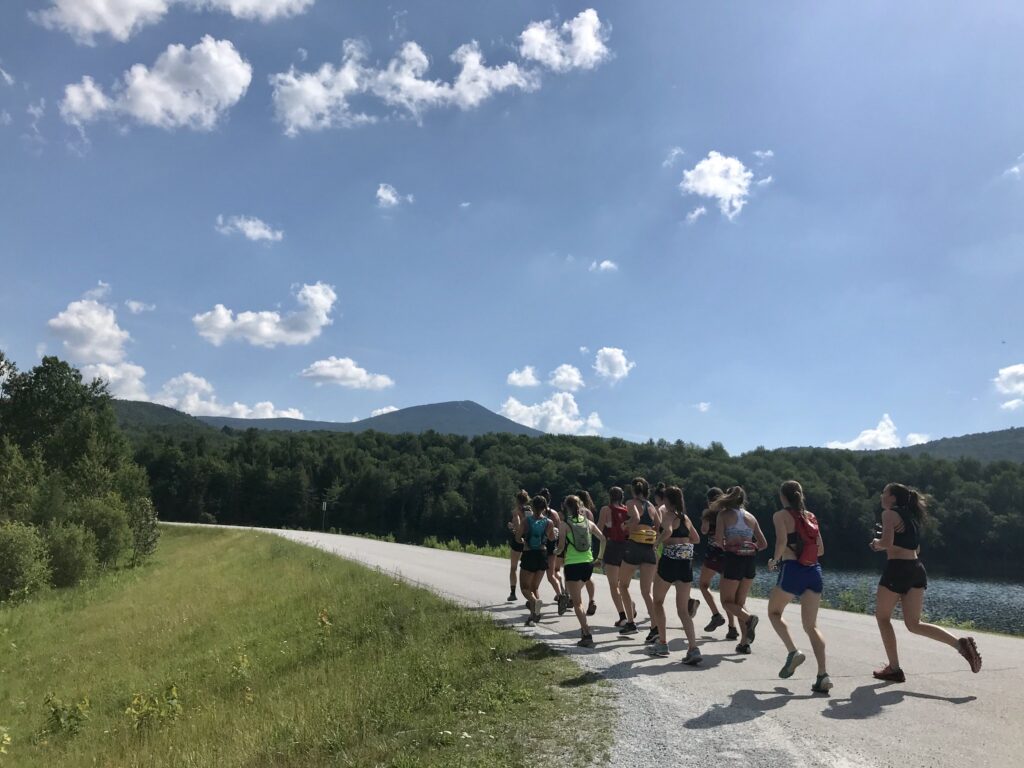
This Saturday, a small crew of dedicated Pugs set off from the Richmond Park and Ride on run that spanned 20.5 miles, 3 hours and 45 minutes, and 2,500′ of elevation gain. The average pace was 10:30-10:50/mi for the entire run (depending on various GPS watches), generally only held back from single-digits by the steep and twisting terrain of the Cochran’s and Chamberlain Hill singletrack where fast mile splits just don’t happen. On the dirt roads and connecting segments, the squad was cruising and talking at a comfortable 9:00/10:00 pace, and for the final 2 miles of dirt road both Sam and Rose absolutely hit the afterburners and cranked out 7:00/mi pace in some otherworldly display of runners-high the likes of which has never been seen in these parts of Vermont.

“Early days” as the Eurosport commentators say. Taylor and Brady joined for the first 11 miles (Taylor then ran a few more on his own for the half marathon edition) and then departed after a jump in the river

You know it’s gotta happen with our crew…this was cached by me beforehand at mile 16. Not pictured is the 2-liter bottle of flat coke to round it out. Ultrarunner staples!

The last two scenic miles, just as Rose and Sam started to absolutely smash some 7’s en route to the burgers and swimming hole

I’m usually not a numbers nerd for training pace (or even heart rate, always) but one of our summer goals, composed way back in the April Quarantine, as quoted from our shared coaches doc:

“Continue to develop running pace and fitness with GPS and measured consistency”

So the combination of early-season track pacing workouts, more 3km timetrials than usual, purpose-chosen routes on gradual dirt roads instead of only grinding hilly trails, and just more days of running in general, has led us to steadily become more efficient over time at this mode of training. And it’s one we can utilize a lot more for both hard and easy workouts. We never in a million years could have pulled off a 20-mile run a couple years ago, and in this case most of the participants of that run showed up Sunday morning and completed a hilly 2hr classic rollerski to boot. However, I will say that I was in a lot worse state than the rest of us seemed to be from the run, and was glad to be on driving duty.

If you’re doing a big workout, remember the golden rule: “If it’s not on Strava, it didn’t happe.” Although in all seriousness we should not get too sucked-in to Strava…it’s pretty cool to be able to look back on stuff like this. Above is Silas’ data from the run

Of course, a whole week elapsed before this mega weekend even happened! On Tuesday there were skate intervals to be had, with the older group tackling Christmas Tree Lane in Williston. A great spot for anyone interested: rolling climb for 3 minutes, with a reasonable descent that can be handled on skis without a car or van shuttle. A portion of the older crew was still feeling the effects of the LAST busy weekend so we had some choosing to opt for an easy distance ski instead. But those taking on the intervals got a great effort in.

On Wednesday it was time to “grind the gravel” just like our Masters have been doing this summer. While we don’t have gravel bikes like a lot of the older MNC contingent, our mountain bikes worked just fine. Knowing there was a big weekend to come and some interval work again on Thursday, we picked a very flat out-and-back almost every athlete in the area is probably familiar with: Cochran Road to Waterbury and back via Duxbury. This ended up being 25 miles and a perfect 2 hours…oh, and it turns out even this “flat” ride had about 1000′ of elevation gain. Guess truly flat stretches are hard to come by in these parts.

Out to Waterbury and back,, the peloton speeds on

On Thursday it was back to the rollerskis for some classic. In the case of the advanced U16 squad this meant some longer L3 interval action, which encompassed a pretty big stretch of the west side of Southridge. I jumped on a bike in my ski boots and pedaled alongside for the interval portion of the ski, because it was time for a little video action!

And now after a long week with anywhere from 15-20 hours of training depending on the athlete, it’s time for a breather. We’ll have 3 off days this coming week (Mon, Wed, Fri) to rest up and take in all the training. It’s hard to believe we are cruising right through August, but I’ve never been more confident in what this group has done and what they can achieve. I’m starting to get deja vu writing versions of that line, and that’s pretty exciting.


Masking Up at Training: A note from Coach Adam

A note from Coach Adam

When we first began training amid this pandemic, we did a great job of following guidelines. Most everyone showed up to practice with a buff on, or at least in their bag. I kept a handful of buffs washed and packaged in individual ziplock baggies to give out, lest anyone forget. We pulled our masks up when we passed people on a trail or bike path. 

But concern faded, complacency set in, and our groups grew in size along with the permitted group size that the state put in place. At this point almost the only skiers wearing buffs or masks at practice are the coaches. We haven’t strictly enforced any rules, we haven’t sent skiers home from training, and while we check temperatures and request personal safety and common sense with sickness, we have drifted into the deep end of the pool of responsibility. 

I am as accountable as anyone here, as it is literally my job to provide a safe training environment, not just a fun and productive one. I think we’ve succeeded on those latter two goals this summer, and now it’s time to close the gap and stay safe from the virus just as we’ve stayed [relatively] safe from cars, pedestrians, crashes, injuries, and phone calls from angry town residents. 

The State of Vermont has now issued a mandate that masks must be worn in public places where 6’ separation cannot be maintained. Newsflash: we are kidding ourselves if we think we spend the entirety of every training session (whether running, skiing, or biking) 6’ apart from each other. Are we engaging in “vigorous exercise”? You could call it that. But we’ve had a simple solution since day one, the same one we began with and have steadily drifted away from: wearing a buff around our necks. 

We got too comfortable, and it’s not fair to ourselves, our teammates, or the rest of the population that we see on a regular basis. We pass MANY pedestrians on the streets and paths near Allen Brook School. We ride around families of beginners and shredders alike on the trails at Cochrans. And we never know when we might have to stop and help a teammate who broke a pole, got a flat tire, or needs an extra package of gummies…these are all situations where we should be covering our faces for the same of ALL PARTIES. 

How do I know we’ve strayed so far from both the mandates and the suggestions? When I post something on our social media accounts, I have to always check twice: if people seem too close, the photo doesn’t go online. If there aren’t masks in a situation where there should be, the photo doesn’t go online. The sign of a safe club training environment is one where I can snap a photo at any time and publicly distribute it! 

A buff is non-intrusive, it can be work with a helmet on and easily pulled up or down (as opposed to an ear-loop face mask), and it’s really not that hot…on Saturday afternoon in the warmest part of the day I went for a mountain bike ride with a tank top on and a buff around my neck. Ten minutes in, I had forgotten the buff was even there, save for the fact that I was able to pull it up over my face if I approached another rider on the narrow trail. 

That’s the mentality and the action we should all be striving for. We’re lucky to be in the state that currently has both the lowest positivity rate, AND the lowest total case count, in the nation. But we only got here by being diligent, and we’ll only stay here by remaining diligent. 

Now that we have entered a new month, a chance to reinforce strong habits is here. Please wear a buff around your neck at every practice. I have a supply of around 6 extras that I will keep on hand should athletes forget. I will try to both be more accountable myself, AND hold the team accountable. 

Coming soon: MNC custom facemasks for school! 

-Adam

Social media & sharing icons powered by UltimatelySocial