The Vermont City Marathon is a huge event that is definitely a sign of summer’s arrival. It’s also a who’s-who of local athletes and active folk, who turn out in droves to race, cheer, volunteer, or just mingle.
Naturally, there were quite a few MNC members and friends of the club at this year’s event. We’re no doubt going to miss a few names, but here is just a sampling of the faces in the crowd affiliated with Mansfield Nordic! If you were at the event and would like to be added to the blog please let me know, and if you have any photos of the event we can add to this post please let me know: adamRterko@gmail. Thanks!
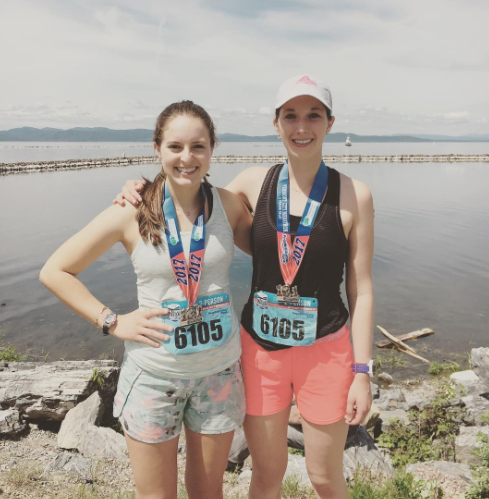
MNC Masters Ken Bruce and Ellie Bouffard did the half marathon, as did junior skier Eliza Thomas!
Eliza (L) cranked out an impressive 1:38 half marathon!
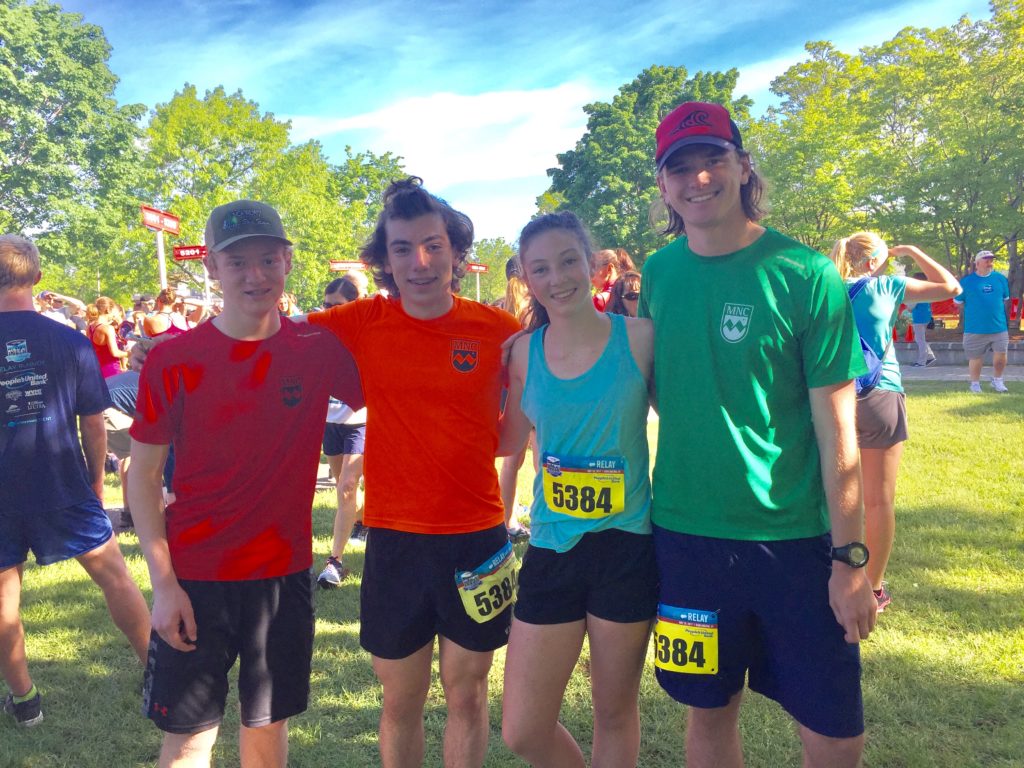
The team of Eli Grossman, Tim Cobb, Sammie Nolan, Will Solow, and Ben Carnahan (racing as Mansfield Nordic Club) took home first place in the Mixed Junior Relay, while Camille Bolduc and Ava Thurston helped their team finish 2nd in the Junior Girls Relay.
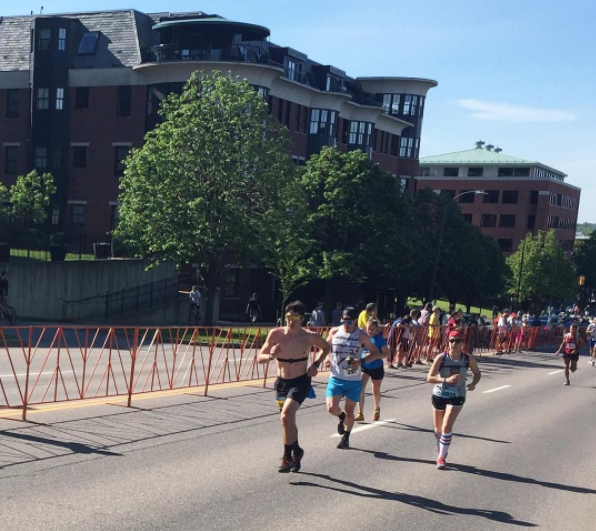
Will Solow charging up Battery Street in a definite “skier” outfit: no shirt, heart rate monitor, and trail shoes 😉
Junior coach Sara teamed up with her Skirack coworkers to compete in the relay as well, and BKL coach/MNC parent Tom Thurston ran the whole thing and was 4th in his age group!
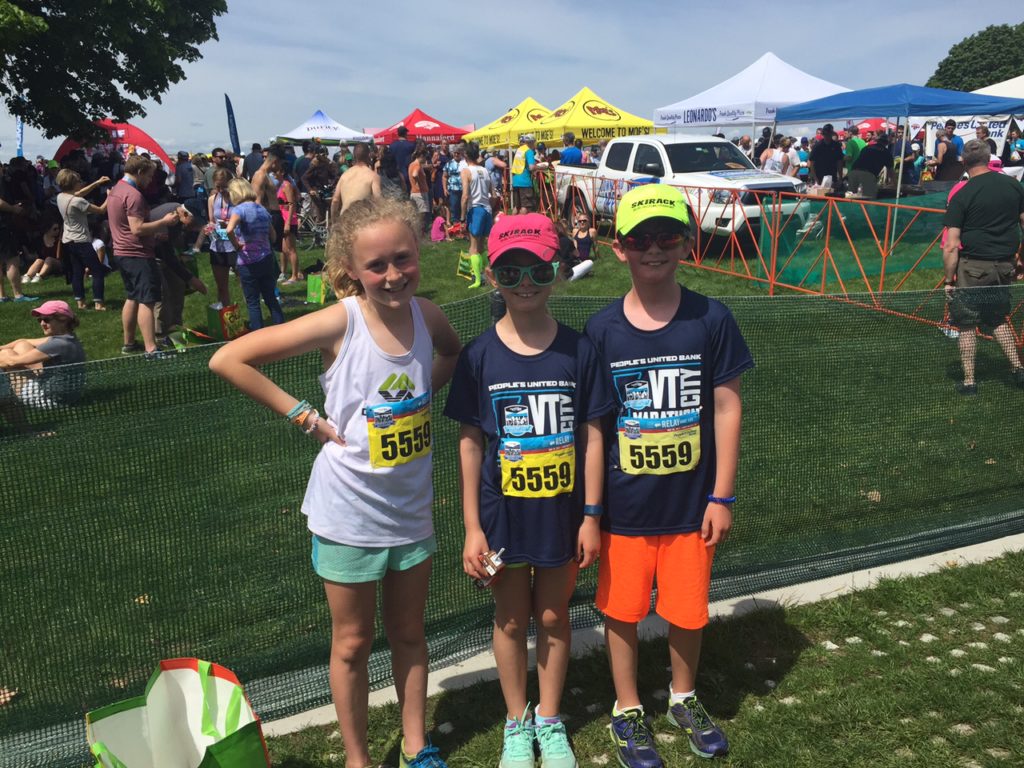
Julia Thurston, Kate Carlson, and Taylor Carlson teamed up with some adults to run a great relay…pretty cool to see young athletes getting in on the big event!
Julia, Kate, and Taylor! Thanks for the photo Jenn
Congrats to everyone who ran, and we hope you are enjoying at least a day or two of recovery, stretching, and icing sore muscles 🙂
Our Saturday training sessions for Juniors are often a chance to make a simple workout into a more elaborate affair. This past weekend we combined what was originally a combination rollerski/run into a day of travelling down beautiful roads and then working on some trails of our own.
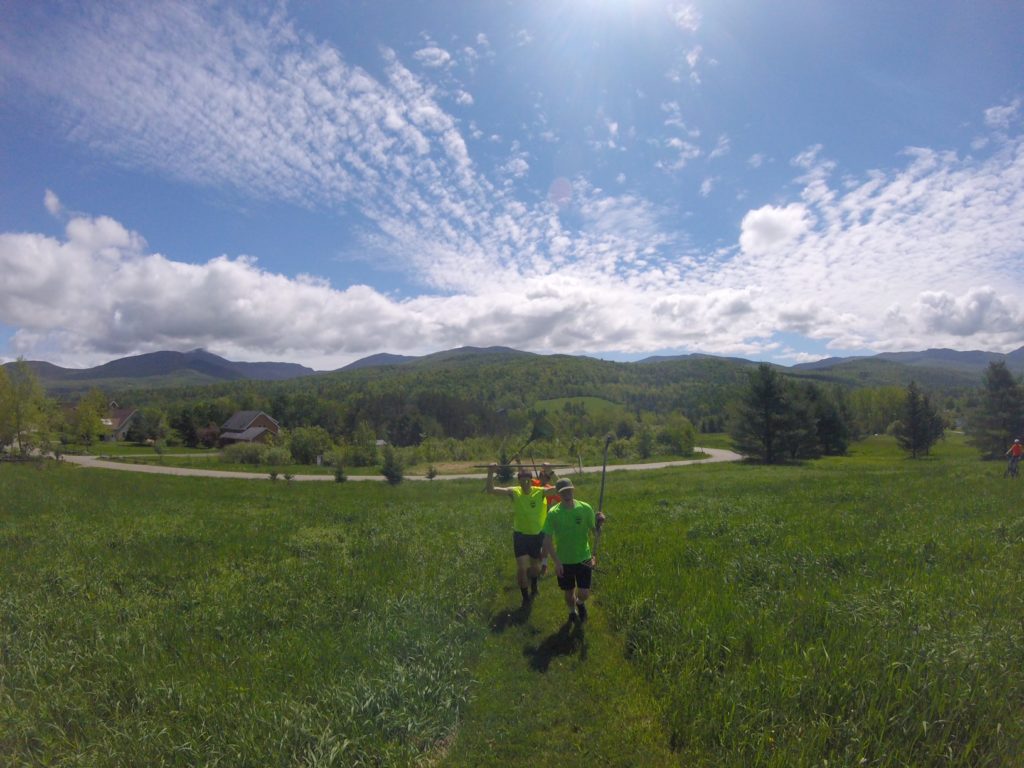
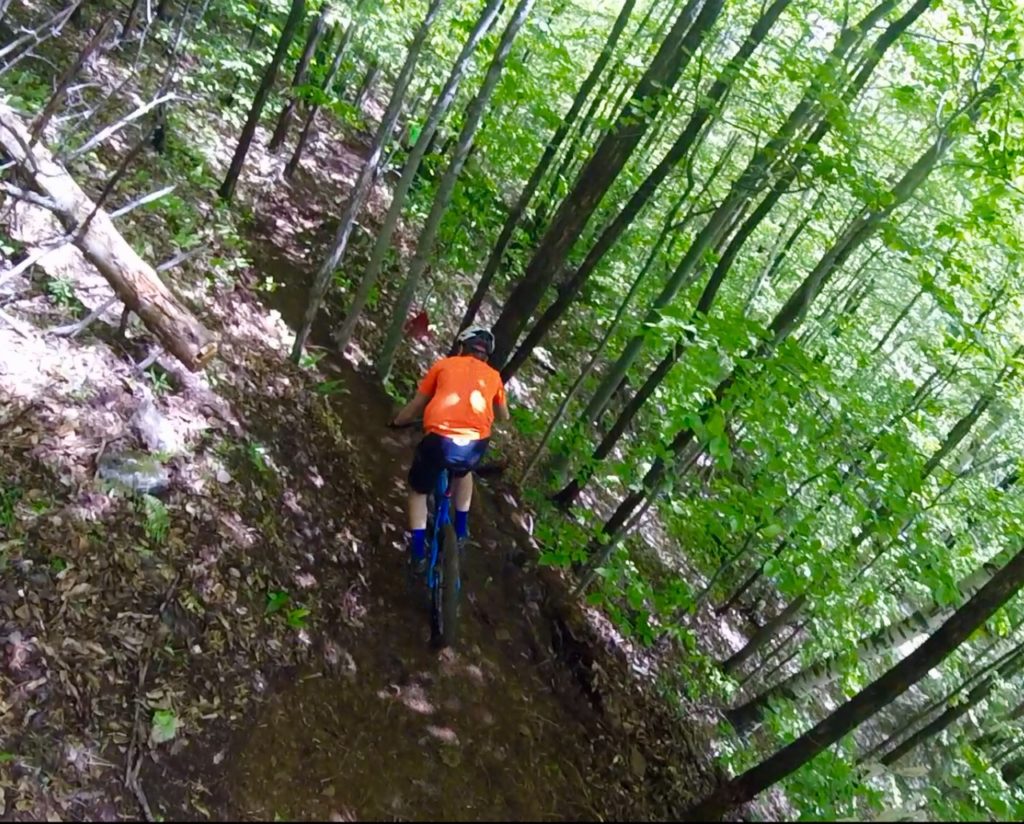
On the small mountain behind the Burt’s and Richer’s neighborhood is a network of homemade trails for mountain biking and trail running. After our very sunny rollerski out toward Hinesburg and back from town, our crew gathered up some tools and headed into the woods to dig, smooth, and rake a new section of trail.
Headed up to the woods, tools in hand
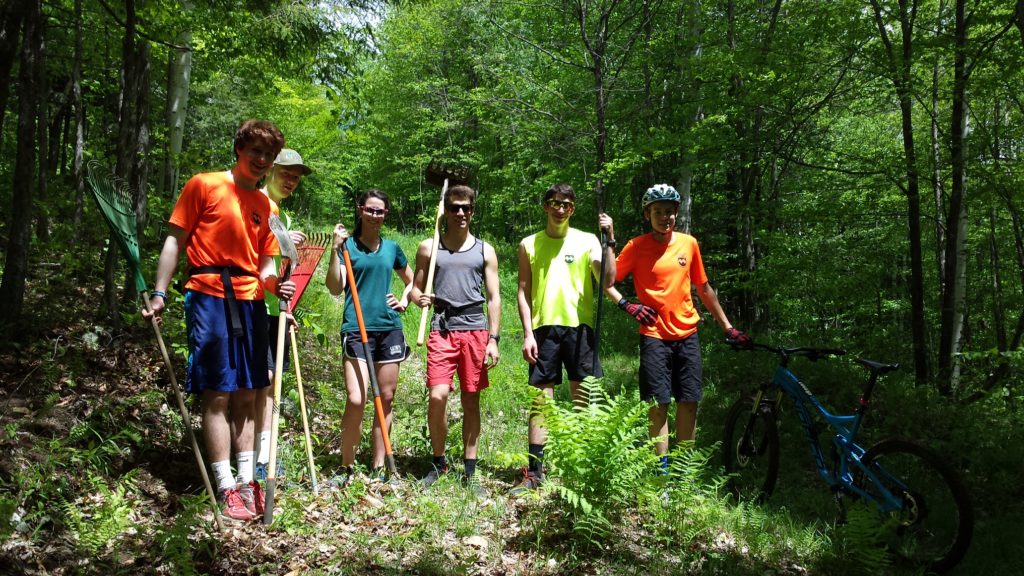
Under Steve’s guidance we carried large rocks to make a cliffside turn, scraped away debris and leaves to pack a smooth surface, and benched out hillside into a rideable section of trail. Nothing makes you appreciate the work of trail builders like spending over an hour crafting a portion of trail with 7 people that takes about 8 seconds to ride!
Not a bad weekend to cap off the first volume week of the year for the Junior Team. Yesterday we raced the first Bolton Hillclimb TT of the year and added some speedy times to the archive. For some it was the first Bolton test ever, while for others it was a nice chance to get reacquainted to the ski trails without snow on them.
You can view the updated Bolton Hillclimb TT archive HERE.
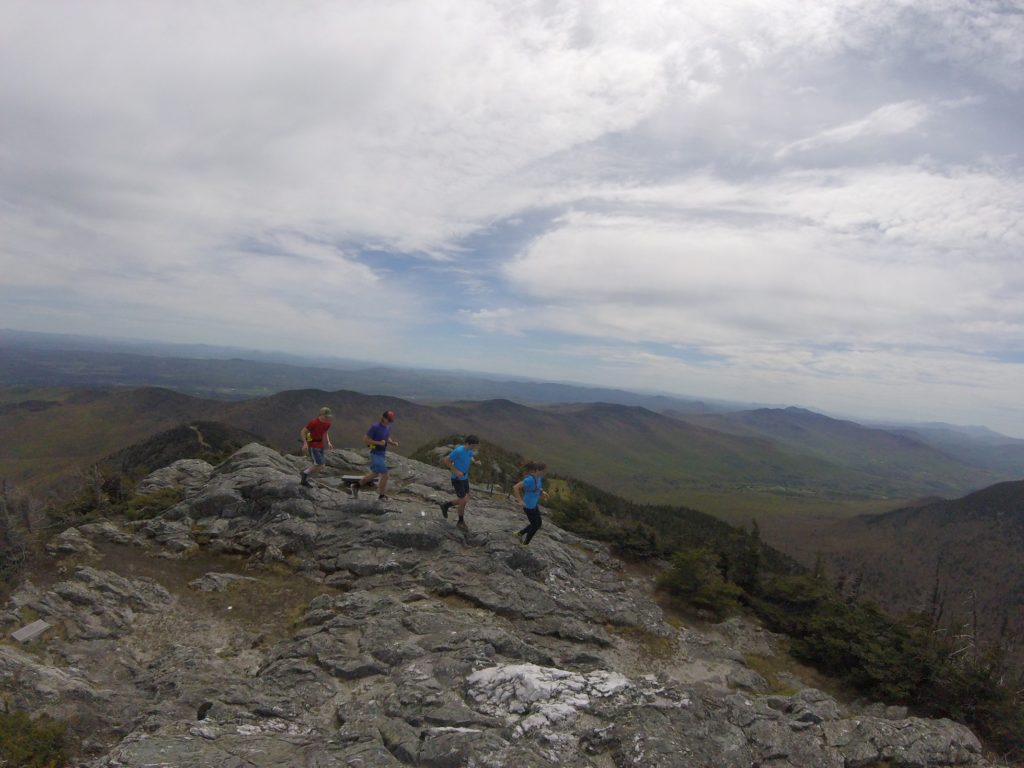
But we weren’t quite done with mountains after that. On Sunday coach Sara invited us up to the Canadian border for a segment of the Long Trail taking us up an over a few peaks, culminating with the summit and descent of Jay Peak. One of Sara’s projects this summer is running the LT in segments over the course of various weekends. While the call of the wild wasn’t enticing enough for the entire crew, some hearty souls like Ben, Will, and Timmy gathered at the Park and Ride early for a lengthy trip.
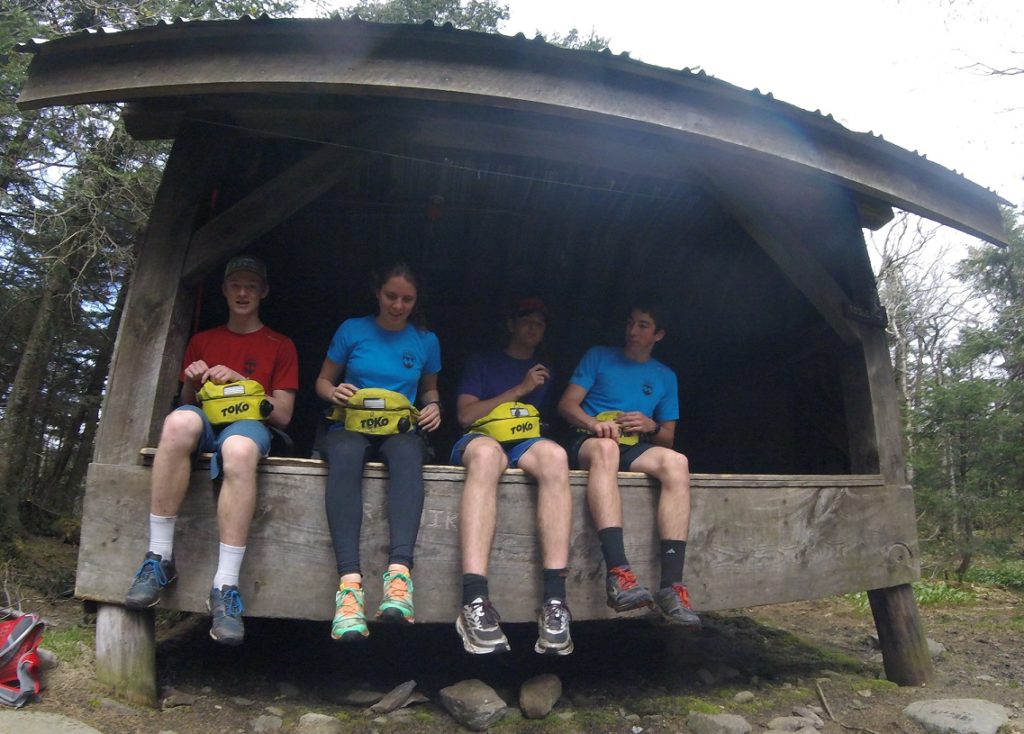
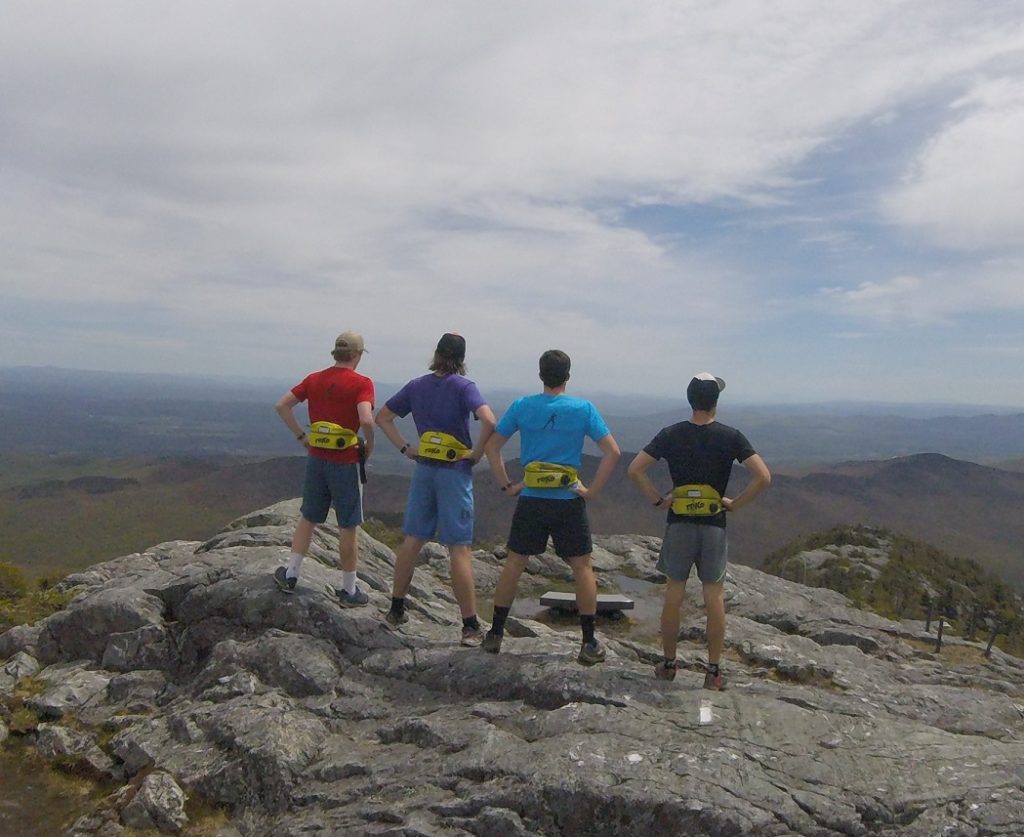
Shelter break fueled by Toko water belts
We were able to run about half of this segment, and ended up hiking/climbing the rest, dodging some wildly scattered debris that had the trail looking like a hurricane had blown through in many spots. In the course of 3 hours we covered 9 miles of rugged trail, with barely and signs of civilization or other hikers in sight until we reached the ski trails at Jay and began bumping into Quebecois trekking parties on the path down to the cars. Gotta love those uncluttered NE Kingdom adventures.
Taking in the view from the top of Jay
Some burgers and club sandwiches at the Jay Village Inn were the ideal way to replenish our carbohydrate stores after the session. Good eats for the money; thanks to Tom Thurston for the tip on that one. We were some of the only people in the joint, and after watching us devour our meals from the other side of the restaurant our waitress came over and asked if “we’d just run a marathon or something”. Guess our eating gave us away, or else our sweaty dirty bodies did.
Now that all the paperwork is official, it’s time to congratulate our 4 graduating seniors who are taking their skiing to the next level in 2017/2018!
Alex Warner is going to continue his momentum from a strong senior year (culminating in a strong showing at Easterns) at St. Michaels where he’ll ski for the Purple Knights next season. We hope our connection with this nearby group continues after linking up for some training last fall because it’ll be great to have Alex back at the Range rollin’ with the Pugs now and then!
Ben Carnahan is headed to St. Lawrence where he’ll trade in the MNC colors for the Scarlet and Brown. Ben dealt with compartment syndrome coming into last year, and faced a hip injury in the fall, but put the setbacks behind him and had his most focused year racing all of the Eastern Cups and more. It’s great to see it culminate in a spot on the SLUSKI team!
Eliza Thomas will make it 2 Pugs-turned-Saints as she also earned a spot skiing for St Lawrence along with Ben. Eliza had strong races in both biathlon and nordic, and the proximity of SLU to Lake Placid means she can continue to pursue both next season.
Will Solow will be a member of the Colby College class of 2022…there’s an extra year in there because this coming season he’ll be training and competing with the postgraduate program at the Sun Valley Ski Education Foundation.
I’m looking forward to seeing and following all that this crew accomplishes in their continuing ski careers…after, of course, they get even stronger and faster during this summer while they’re still in our corner of Vermont! While seeing athletes make progress with their fitness and technique is inspiring, and watching athletes achieve new performance breakthroughs and have their best races is rewarding, the college piece is even more special.
Having skiers routinely leave Mansfield Nordic ready for another step in the ski world is a sign of so many puzzle pieces coming together. While training hard as Junior skiers is maybe the most direct puzzle piece, there are so many other factors related to higher education that these skiers have had to navigate: communicating with coaches and academic personnel, developing the responsibility and maturity to set themselves up for a more independent 4 years, and of course studying hard and showing they’re ready for the new academic loads that will accompany their new training loads.
Some of these puzzle pieces can be fostered by the Junior team, but other puzzle pieces come from supportive parents…engaged community members…caring teachers…some of the ski skills needed for collegiate ski teams are cultivated in the BKL ranks before these skiers can even envision high school, let along college.
It certainly got me thinking, particularly when the news was finalized that Eliza and Ben were headed to SLU. I was interested in SLU as a high schooler, attended and raced as a student for 4 years, and then coached there for 3 years while learning about and recruiting athletes like Eliza and Ben. And now I’m back at the beginning of the cycle from a different vantage point.
I can see many steps MNC takes to help skiers prepare for college skiing: tough training, year-round focus, a balancing act of school and competition, and continuing collaboration with college teams themselves (like St. Mikes) to make that next step clear and engaging. I realize that there are even some aspects of my day-to-day coaching style that I carried over from working at the collegiate level…for example, at races I expect athletes to know their own warmup and ski testing plans and not need their hands held. Does this always go flawlessly? Of course not…but the point is for the kinks to be worked out before an athlete gets to college. That makes it one less thing to worry about for everyone involved.
However, there are plenty of ways in which we could do an even better job of preparing skiers for college. Am I too lenient in training sessions? Do we need to have more/longer mandatory study halls on race trips? How about a template for MNC skiers making college visits and sending info to coaches?
The best way to approach these concepts is to keep trying to improve, keep reflecting, and keep working hard. You know, college-level work…
Although we are on the verge of May, patches of snow still dot the alpine mountains across Vermont. But just as snow melts from the slopes, mud and dirt begin to clear from the roadways. Do you dust off your rollerskis and pound the pavement? Or do you wax up your skis and make one last go at the patches of snow?
Rollerskiing isn’t a perfect match of snow skiing. Of course the skis are a different length, but there’s subtle other factors at play. How fast do your wheels go? Do they match the snow? How heavy are your snow skis compared to your rollerskis? How quickly can you navigate a turn on each type of ski?
Knowing how to “feel skiing” when you aren’t on snow is a coveted ability. That’s part of the reason APU trains on a glacier in July, or why the US Ski Team travels to wintry New Zealand in August. You may have also heard of ski tunnels like the one in Torsby, Sweden. Getting access to snow whenever you want is certainly a treat. But when that’s not possible you can look for ways to both keep the feeling of snow alive while also learning about how it differs from rollerskiing. In the end, this should make you a more adept and aware rollerskier!
It takes a certain set of conditions to create what we got to experience on Saturday, which was BOTH rollerskiing and snow skiing. No glaciers or ski tunnels required.
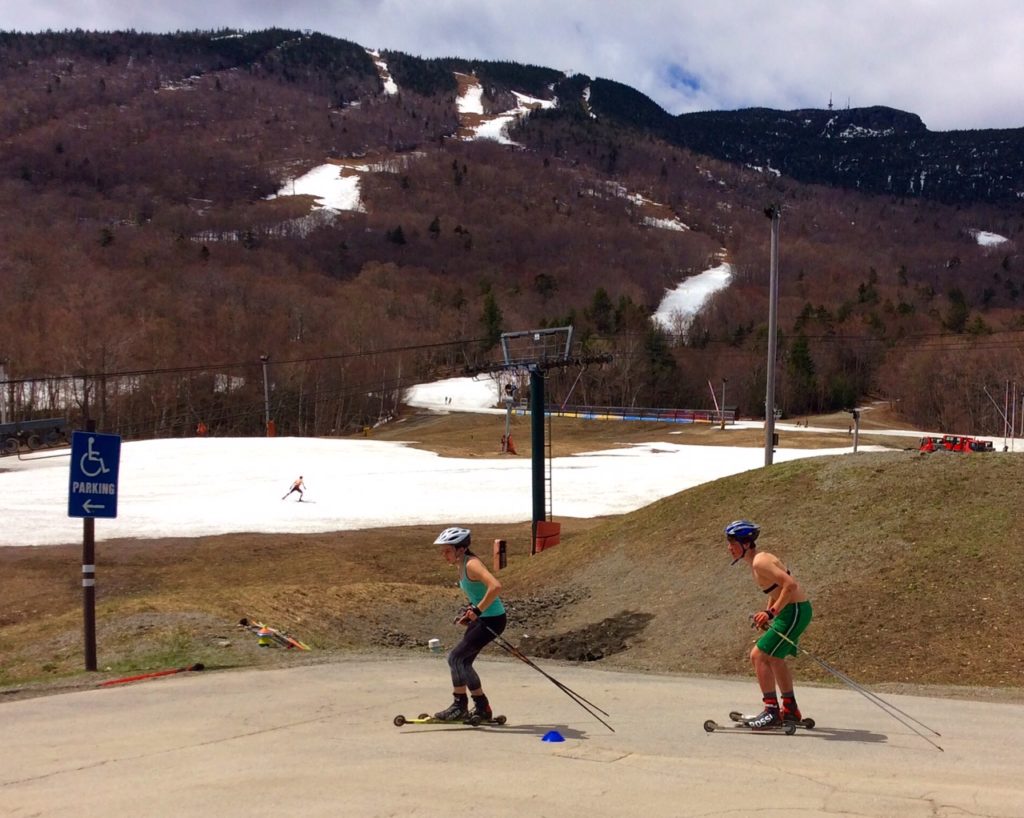
A week prior during our Stowe NorPine adventure we realized there was a big parking lot adjacent to a nearby patch of pretty level snow. We packed both skis and wheels into the cars and made our way there yesterday where we found the perfect situation: a street-swept empty parking lot with a 50-foot walk to some corn snow. We set up a little loop and rollerskied for a while, doing some of our favorite drills. Then we switched right to skis for a few laps. Then back to rollerskis. We took video of each method and discussed how they were similar and different.
Finally, we ended with partner relays: Partner A did the rollerski course, and as they crossed the line Partner B took off on the ski course. After 2 laps each, Partner A and Partner B swapped roles and changed to either skis or rollerskis. Pretty cool to have both types of skiing happening at once.
Ali and Sammy roll, while Adam Glueck glides on skis in the background
Of course when snow is involved, we knew we had to call up Adam Glueck to join in the fun. We got lots of technique footage which is on the MNC Youtube Channel, and I also put together a quick little clip combining the wheels and the snow:
So, what did we learn?
Rollerskis give lots of power. The snow was soft, admittedly, but it was very evident hot much power return the rollerskis gave (even composite rollerskis that flex). With snow, you were rewarded for keeping movements smooth and extra wasted energy was compounded. On rollerskis, you could still move pretty well and get plenty of glide even with somewhat inefficient body position.
Snow skis are long and force you to shift weight in V1. On rollerskis, your feet can wander in, up, back, and all around. It’s much harder to get this effect with skis on, and so there is extra need for good weight shift and a dynamic lower body that applies power to help the body move from side to side.
Rollerskis can turn on a dime. Not only are they shorter, rollerskis edge almost perfectly thanks to sticky rubber wheels. Navigating cones and slaloms on skis places a greater emphasis on “reading” the line into each turn, as you need to account for the angle of the hill, the snow type, the radius of the turn, and more. This is still crucial in rollerski agility courses, but you can get away with much more just by hopping, stopping, and changing direction quickly. On snow, if you try to turn to fast you wash-out, skid off the ideal path, and have to completely re-adjust. There’s a metaphor in there somewhere…
Below are some more clips showing different techniques on both snow and pavement…see what YOU can notice about what is different and what is similar…