Intro Rollerski Clinic Recap

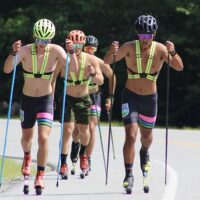
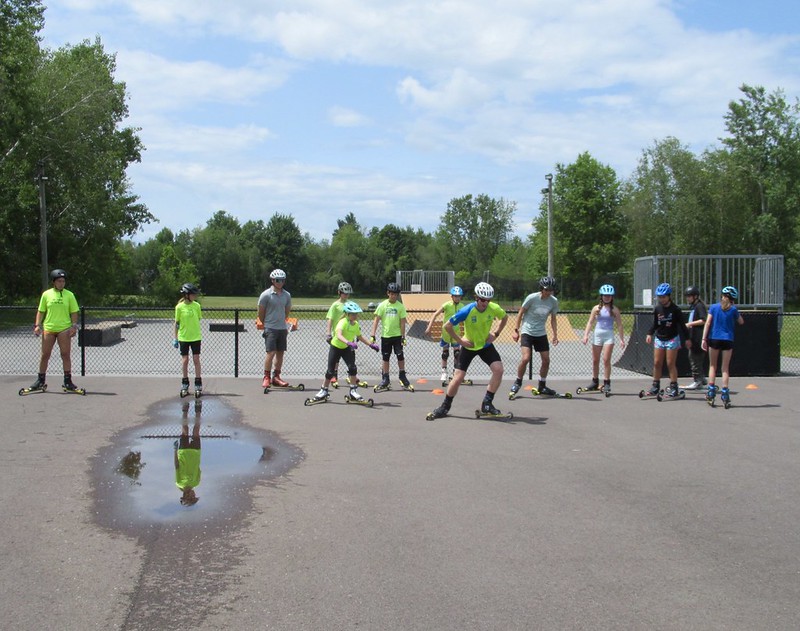
We had a great turnout and a lot of fun at this year’s first Learn-To-Rollerski clinic in Williston! 13 young skiers took part, and it was great to see a “dad squad” get out for a group ski while we were underway.

Several in this crew had never rollerskied before, and everyone was able to confidently get around the 1km loop at the Village Community Park (WCS) by the end of our day. A pretty sizeable chunk of skiers even ventured safely out into the neighborhoods for a quick trip around some familiar cul-de-sac pavement.

It’s always tricky to know just how to approach a group rollerski lesson…the ability levels do vary quite a bit, even among those who have never rollerskied before. That’s because balance, confidence, and spatial awareness play such a huge role in what we do, and those things can range on a wide spectrum before even clicking into a pair of bindings.

To that end, the focus usually follows a consistent pattern…start off skis, work on body position, and incorporate some bands to get the muscles warmed up.

Next, progress to skis but no poles yet! It’s time to work on general movement, turning, and importantly how to slow down and stop.

Then the distance can be extended, still without poles for a time. Poles can be added gradually after this, with a focus on V1 since it less balance-dictated than V2.

It was great to have a handful of Juniors with us to help coach, since this meant we could divide up groups a bit based on ability. Thanks to Anders, Niko, and Taylor for helping out! All-in-all, the progression mentioned above doesn’t sound too different than a regular MNC Juniors training session, albeit just on a slightly different scale. Proof that there really isn’t any magic after all.

We’ll be having another clinic like this on Saturday, July 29th so keep an eye on this site for more info!
New Bolton Record! (and it’s not what you think)

We have data on the Bolton test going back many years. It’s one of the tests I “inherited” when I started coaching at MNC, so in the record books you’ll see times from 2013, with names that have long since gone to college, and even started and retired from professional ski careers!

So yes, this September will mark the 10th year of this test if the archives are accurate.

Often, I’m making claims about how much faster athletes are getting, and indeed the top times have consistently plummeted in the past 3-4 years. The times are decreasing for a few reasons. In part, it’s from us only getting faster as a club. But there has also been a marked increase in skiers taking on this test. The sample size has gotten huge, and with more skiers come more chances to throw down fast times. Skiers from other clubs give it a go, as do collegiate skiers and adults in our sport.

But individual progress has always been a key marker, and having a tab on our archive that follows evert skier over the years is super valuable.

And on Saturday, a new record fell! No, not the speed up the mountain (although Keelan Durham and Hattie Barker were close to some record times). This was a record in the number of racers in a single Bolton test day with a total of 30 competitors.

Philosophical club question: is this record more important than the record for time and speed?

My answer would be yes, because this record signifies growth in participation, excitement, and willingness to compete. Our MNC University group brought many new racers to the table, and friends-of-the-club made appearances too. 14 results were added to the men’s recordbook, and 16 results were added to the women’s record. That’s some great parity as well.

The speed records are likely to be broken again, and the likelihood it happens sooner is higher when we’ve got more competitors. So it’s really a wholistic process: more athletes and a broader range of racers means more chances for the record to fall, and a wider range of times in each test (meaning no matter what speed you’re going, you likely have someone racing near you for good competition).

That’s a much stronger barometer of ski club testing results than simply relying on “super talent” skiers or runners to keep lowering the course record!

Although some had to jet for graduation or work, we still had a pretty big group shot at the top of the lift!


Great new rollerski technique videos

The Norwegian website Langrenn, a hub of XC skiing in Scandinavia, has recently released a slate of Youtube videos featuring elite-level skiers demonstrating modern technique on rollerskis.

With ski technique and our understanding of the human body (and equipment and race types) always changing with time, it’s important to use current resources like this in our approach to skiing. You can check out these videos below. These clips are all focused on classic technique.


Getting screened

Aerobic capacity, specific strength, agility, performance mindset, “killer instinct”, teamwork, motivation…there are a lot of puzzle pieces to successful cross country skiing. But often, we can overlook one of the most fundamental components of what we do…movement itself!

Our movement competency forms the foundation for all physical aspects of sport, and luckily for us there is a wealth of knowledge, scholarly work, science, and research on the topic. Is it as dynamic as brutal intervals up a steep mountain road, or as heroic as a lunge across the finish line in February? Certainly not. But we can improve both of those moments (and many more) with a better understanding of how our bodies move in space, how balanced we are, and how strong some fundamental muscle groups are.

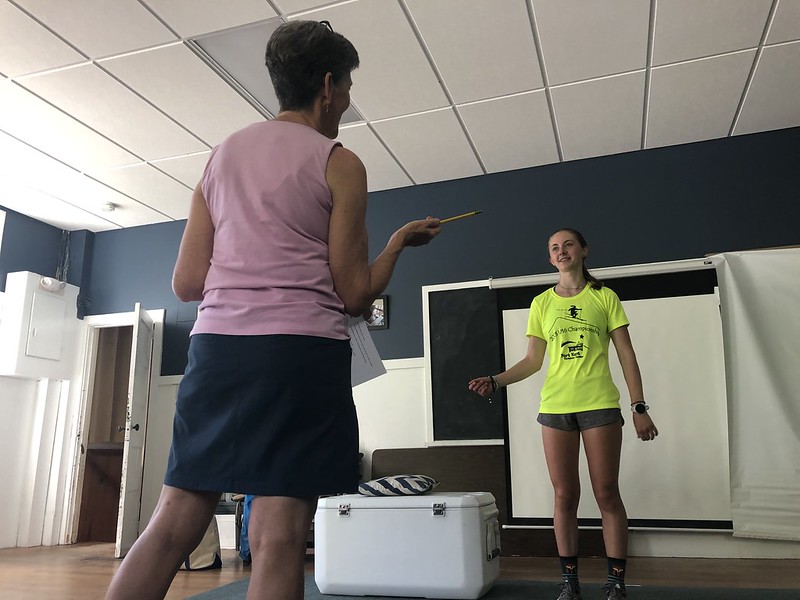
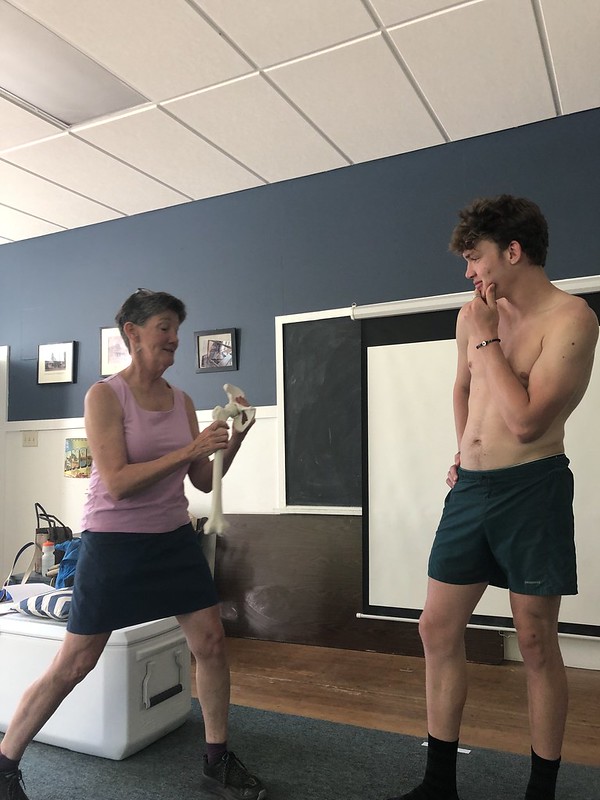
We were fortunate to be joined over the last two weeks by Sharon Henry, PT, Ph.D, ATC as well as Coach Sara (now through her 2nd year of PT school) for some athlete screenings. We rented the classroom space of the Jericho Community Center, and had ourselves a miniature clinic. Individual athletes went through several tests, which are detailed below by US Ski and Snowboard. Sharon and Sara made notes and took down some scores, and athletes were able to get some feedback and exercises that targeted weak areas.

As a coach, it was really great for me to see both individual tests as well as overall themes. We’ve already added a few new exercises to the short warmups we do before each ski or run session, and can now make changes to our strength training plan based off info from these sessions.

Here is a link to a video detailing the US Ski and Snowboard assessment, for those interested.

US Ski and Snowboard Movement Screen

The heat begins

Earlier this spring the Juniors prepared their own electrolyte drinks with natural ingredients and lots of mixing. It felt a bit odd because at the time we were wearing coats and long sleeves, and the wind and rain were making outdoor training feel like November.

But by the time this weekend rolled around, we were definitely doing our best to hydrate any way possible!

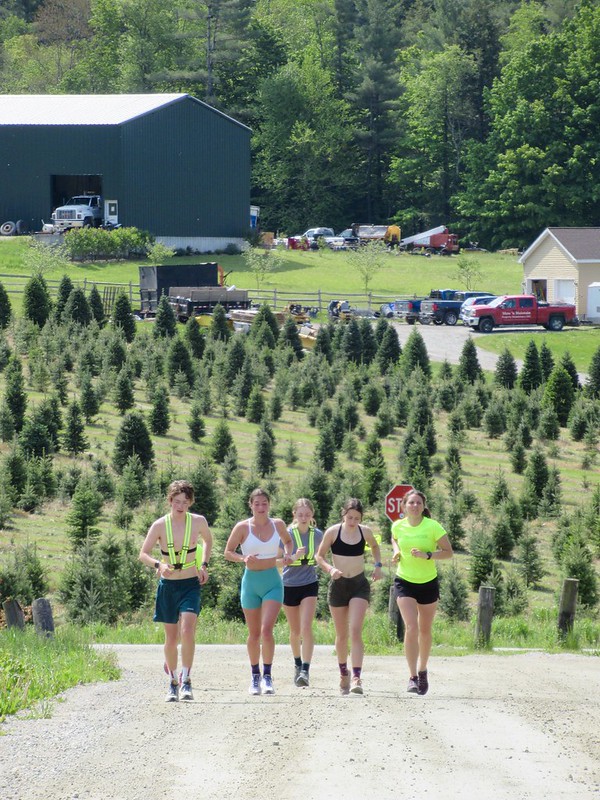
We began the week with solid rollerski efforts focused on no-pole work and then some lighter intervals (our first day outside of the Allen Brook rollerski network!). Then it was a weekend of two longer, more involved days of adventure.

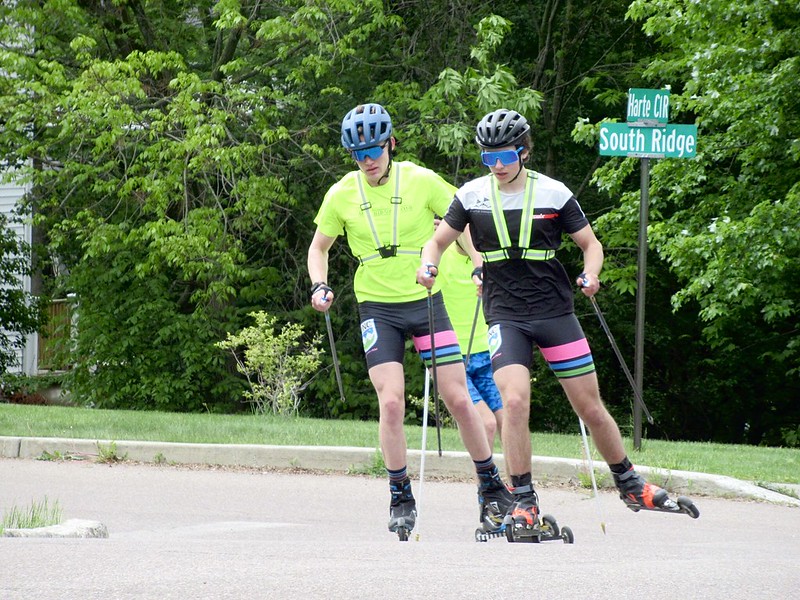
Focused intervals in Southridge for Kai and Nico

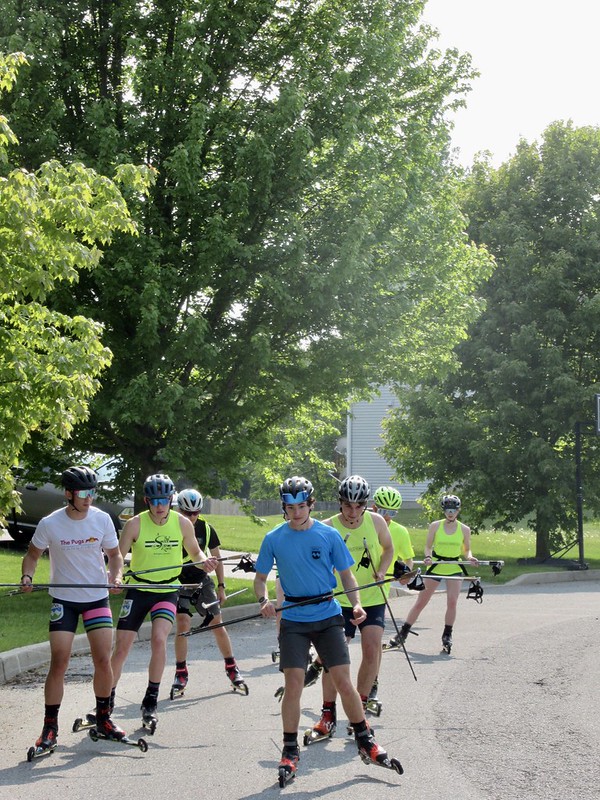
The gang works on their no-pole skiing

With the traffic light and the skies sunny, Saturday was a good “lap of Richmond” where we started on rollerskis and made it down Cochran Road, up into Greystone, and eventually up the dauntingly-steep Wes White Hill. When the pavement turned to dirt, we swapped skis for running shoes at the van and travelled to Huntington on foot. With a right turn on Mayo Road to take us back toward Richmond, it was a nice route that could definitely be expanded into a longer loop later this summer.


Out cruising past the tree farm

Last summer, a small group ventured down to Rochester, VT for a tour of the new Tunnel Ridge trail. It was right after this video came out, so we were excited to experience all these berms (and all this climbing) for ourselves.

We had a particularly hot day for this year’s edition of the Tunnel Ridge ride. The hearty crew of Jonah, Taylor, Lorenzo, June, Kate, and Kristen (and Adam) were in for a lot of sweating, vertical feet, and hordes of flies at the summit. This trail ends up being 3,000 feet of climbing in 15 miles…pretty solid effort in the saddle.

Luckily the river was just barely warm enough for a quick dip after the ride, the ice in the cooler kept some popsicles at least semi-frozen for our return to the van, and Mad Taco was of course open for the weekend crowd.

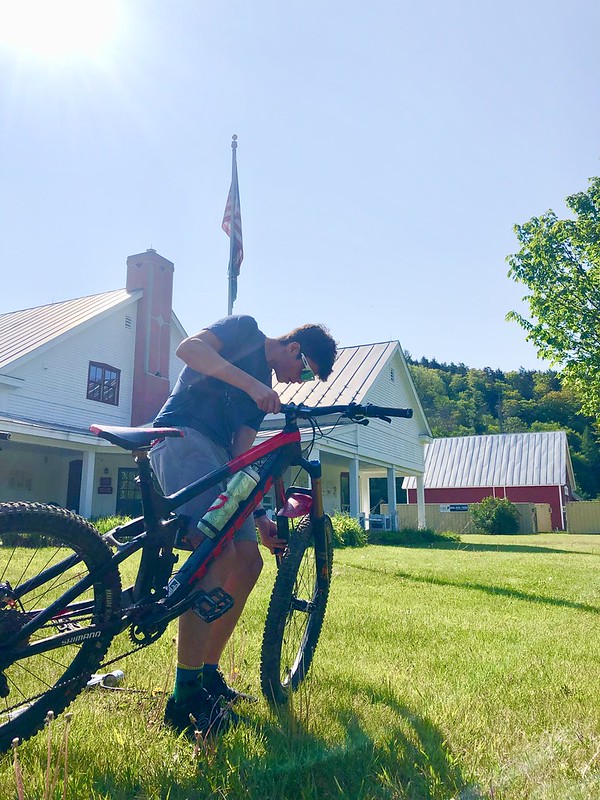
Jonah prepares his bike at the Ranger Station

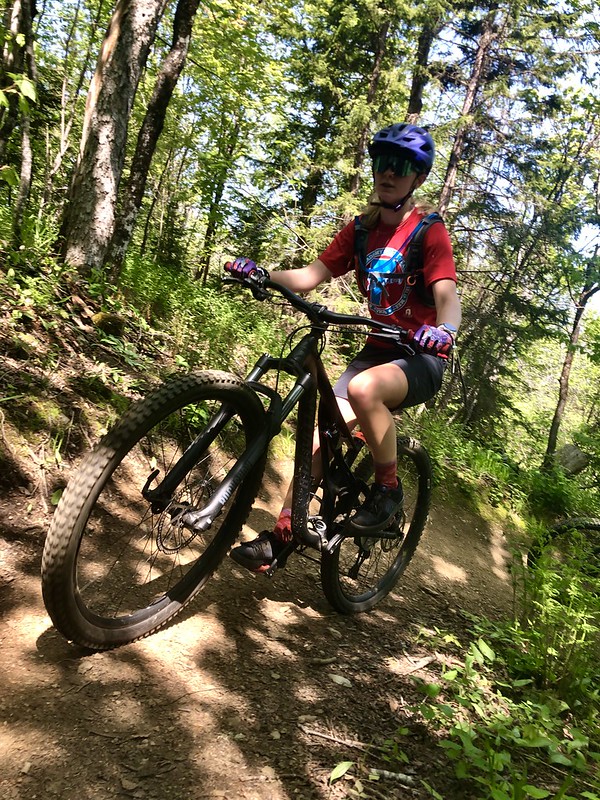
Kate at berm 80, or is it 90? Or 100?

This was definitely an example of “type 2 fun” or maybe even a step beyond, as many mentioned being too tired from the climb to even enjoy the incredibly lengthy and flowy descent back down (the treat you’re [supposedly] earning by all that work to get up top). It was definitely more than we probably should’ve tackled in May, but it should be said that uphills were written down on many a goal pyramid this spring for something to work on…so why not go big?

Hot weather is continuing to hit, so this week will be a real test of our preparedness for training each day. We’ll also be looking for/incorporating some unique ways to stay cool while we are moving along outside!


Social media & sharing icons powered by UltimatelySocial