Author Archive | Adam Terko

Both ends of the spectrum

It’s funny to see so many different moods and modes play out at training every week. Sometimes it’s the weather that causes a stir, with rain or sleet making just getting through a workout a chore. Other times it’s the challenge of the intervals or distance that brings out the challenges. The atmosphere can change in an instant and is influenced by a thousand possible factors.

This week there were two distinct days that brought out all sorts of emotions. At first I was motivated to do a fun, cheery blog post all about how great Saturday was. But then I realized that I couldn’t talk about that day without at least going over Thursday in a little bit of detail. Sometimes the best laid plans (or unlaid plans) don’t quite turn out as intended.

At the USSA conferences and presentations this spring, it was suggested that coaches “let the athletes design and carry out a session” as a way of sharing accountability for training, as a teambuilding activity, and as a way to get deeper than just showing up to follow the directions. Coach Dana and I talked about this at Mountain Camp, but we never ended up putting it into practice. There was just so much else going on that it was enough to stick to a plan at all.

But last Thursday, I figured it might be a chance to test out that workout idea. There were several factors that I thought would work in our favor:

-Smaller group size, with no U16s present for this workout. It was only the older Juniors

-An easy workout on the schedule, which wouldn’t involve much “hands-on” coaching regardless

-Myself being with the other summer group at a different location…so it would be even more “hands-off” from my perspective

I left Coach Rosemary and Coach Perry with some loose instructions: the group was to decide among themselves how long they’d ski, how long they’d run, where they’d do each part of the workout, 3 drills to do and why they chose them, etc…I came back from training with the other group that day to find a plethora of disgruntled training log entries that keyed me into how it had actually turned out.

Not surprisingly I think you could say it got into a little “Lord of the Flies” situation. Which isn’t all bad: without struggle or adversity there isn’t usually any change. But the workout got a bit muddled, and the translation that ended up lost was between the desire for group discussion and problem solving, and the feeling of “why aren’t we just training by ourselves if this is how it’s gonna be.”

I realized that what I’d done poorly in planning was to not give enough direction to the coaches, even though there was technically no direction intended. Realistically, I should have described in greater detail WHY we were doing this workout in such a manner, and WHY it was important. Without a reason, a group activity doesn’t feel like a group activity so much as a pop quiz. And with school starting up soon anyway, nobody wanted a pop quiz at ski practice.

It’s pretty cool how quickly things turn around though, especially with this positive and hardworking crew. On Saturday we had some bounding scheduled at Bolton. In the afternoon, an easy double pole in Richmond was on the schedule. I got a message asking if we could offer the option to do the second workout closer to the finish of the first one…maybe just a quick break in town so that there wouldn’t be driving to Bolton, back home, and back to Richmond. I made some changes and sent out a few messages and it sounded like a group was in.

It was a gorgeous day in a week of nice weather, and the bounding was very productive. We found ourselves on a part of the Catamount and V.A.S.T. trail that we’d never explored before during the warmup, partway up the access road by the Sugarhours. We followed trails from there up to Bryant Cabin, where one group did a final interval around Birch Loop in the thick moss and rooty undergrowth feeling very much like a greener and even hillier version of Sweden’s woods.

Warming up on some snowmobile trails deep in the forest

These are some beautiful VT woods if I’ve ever seen them

We gathered back as a group to end the workout, and several in the gang then went to the Richmond Market for snacks and recovery fuel. On this sunny day we all lounged around in the grass on the town green, munching on Goldfish and sipping coffee, before getting ski stuff on and setting off down Cochran Road.

Afternoon workout? Still sunny

A little double pole technique…and then back to the road! People skied longer than initially planned, and it just felt very productive and focused.

All in all, these types of days (the good and the chaotic) serve to show just how strong the power of positivity is. Sometimes it’s about toughing it up and dealing with a workout that doesn’t go as planned, or a workout that wasn’t laid out very well by the coach. And other days, things just come together so well with an easy joy and work ethic. The common factor is a group that’s willing to be a part of it all through both instances.

Ski care in August? YES!

Nordic skiing is going fluoro-free, and that does NOT just mean waxes! Imagine a CSI crime scene where a UV light reveals fluoros…if you turn off the lights and shine it on your wax area, in your ski bags, and on your skis, what would you see
FIS has recently come out with some guidelines on cleaning all your materials. This is important because as thresholds get lower and testing protocols get tougher, stray fluoro particle can jeopardize a race. You would NOT want to use clean, fluoro-free skis and then later have your result stripped because a test found out that fluoros got onto your skis because you accidentally used a contaminated brush in the waxing process!
It is highly recommended that you consider stonegrinding skis this year. If you are a Junior racer and you did not get your skis ground last year, now is the best time. Bring them to Skirack for grinding this fall, or see our option below to grind through Caldwell Sport.
The official word from FIS:
Recommended cleaning of used equipment from fluorinated substances
This document describes the proposed steps to “clean” used equipment from fluorinated substances and reduce contamination down to a level where no competitive advantage is present.
* Cleaning of skis
  1. Clean the running base with a non-fluorinated base cleaner by applying the liquid with a cloth. Then rub the base surface with a fluor-free cleaning brush (stiff nylon). Let dry for 15 min, continue to brush the ski / board with a clean steel or bronze brush.
  2. Perform “Hot Fluor-free wax cleaning” >10 times (iron hot wax – scrape while warm – brush) on each ski and board. Use waxes of different melt temperatures (warm – medium- cold). (Clean scrape and brush after every application)

**********

Grinding the bases of skis/boards is an option that will also remove contamination fluorinated compounds from surface layers. Grinding is recommended for base material made with fluorinated additives since research shows that these additives migrate to the surface. After grinding step 1 and 2 should be repeated.
**********
* Irons
o Scrape off excessive wax. Warm the iron and clean liquid wax residuals with a cloth. Melt
non-fluorinated wax and clean with a cloth.
* Scrapers
o Scrape off wax residuals. Clean with base cleaner, wash with water and soap, rinse
thoroughly.
* Brushes
o Vacuum clean the wax dust from the brush. Use the brush extensively while cleaning skis
with hot wax and vacuum clean between every application. Dip the bristles in a base cleaner and brush over an edge to further clean the brush. Let dry and vacuum clean. As a final cleaning step, one may consider washing the brushes in a dish washer in a high temperature programme.
Warning: As brushes may be the most difficult equipment to clean thoroughly one should consider replacing used brushes with new ones.
* Roto fleece
o Based on experience we recommend replacing roto fleece and similar equipment as they
have shown to be almost impossible to clean thoroughly. * Apron
o Wash in washing machine with high temperature cycle several times.
* Files and file guides
o Brush the equipment with a soft file brush. Vacuum clean. Dip into a base cleaner, wipe
off and vacuum clean.
* Ski Bags
o Vacuum any dust, wipe clean with cloth and base cleaner, wash with water and soap,
rinse thoroughly.
* The Wax Room should be thoroughly cleaned. It is important to remove as much dust particles as possible. A safe and healthy working environment is the responsibility of the user.
The objective of these cleaning recommendations is to point towards both the cleaning as well as dilution effect the above waxing steps describes. As of 14th August 2020.

XC Running and Skiing Notes

Runners!

Some thoughts on XC running and XC skiing. We are at that time of year again where running is starting up in force and the training might look a bit different than what we’ve been up to at MNC sessions. I wanted to share a couple thoughts and things to keep in mind.
I’m also linking this article from Andy Newell that I believe I shared with some runners last year. I wish this article went a little more in depth on a few topics, which is maybe why I’m feeling compelled to write this post.
I’ll try to break it out in bullet points so this is easier to to digest:
1) Base and peaking
I remember the very first time I was taught this it came from Kasie Enman at a CVU Nordic team pre-season meeting in one of those basement classrooms that may or may not still exist.
Her analogy was simple: picture your year like a triangle or a pyramid. The base of the pyramid is wide, and the blocks are big and more square. That’s the L1 and distance training we do all summer: the base that helps us be able to handle all the hard stuff later.
As the season goes on and we get closer to big races, we get higher on the pyramid. The total time drops, and many of the workouts are harder. The blocks are smaller and they’re more pointy…of course, the very top of the pyramid is the sharpest part! That’s the last Eastern Cup/States/Junior Nationals/etc.
The hardest part about XC season is that you get to school and you have a very limited time before the races. In the month of September, you’re suddenly very high up and on the narrow, pointy part of the pyramid even if you may not have climbed up there yet with training…our ski training is all based off being at that top part in February and March, so while we have done 3kms and running workouts, we haven’t done the hardest and sharpest blocks yet. It’s important to make sure we are still incorporating workouts where we have a higher total training load, particularly of easy distance. It’s also important to maintain our ski-specific strength. I’ll go into both of these now.
2) Pacing, racing, volume
We made a concerted effort to work on run pacing this spring and summer. The downside was that many of these workouts were pretty sparsely-attended, as it’s most easy to do a running workout on-your-own. The goal of paying attention to pace was to gradually build into running by taking miles a bit faster than we usually do to both increase efficiency and to be able to run harder in intervals and timetrials without being as sore.
That 20 mile run we did the other week averaged 10:30 or so, and aside from a couple of miles on steep trails at Cochrans we were pretty much running under 10:00 on any dirt or paved roads. We were still able to talk to one another, but we weren’t lollygagging. That’s a really reasonable distance pace and I’d say for any run longer than 6 miles or so none of us really need to be running faster than 8:00/mi, and even that is what I’d consider the quick end.
If 7:00/mi pace is about a 21:00 5km and your PR is around 20:00, it means that by running close to 7s on a distance training day you are really just coming close to a race-pace effort. Doing that day-in and day-out means the line between easy and hard starts to get blurred…and if you can’t recover from your hard run days, your easy days will suffer and it will become a tough cycle to break out of. A lot of times this cycle is only broken by overuse injury or burnout 🙁
My biggest biggest BIGGEST ask of all XC runners this season is to take those easy runs easy. Don’t get sucked into a competitive mentality on the easy days, and use those days to keep the breathing controlled and the body safe from shin splints, hip strain, and stress fractures. Run the interval days like you want to kick the competition’s butt, and you will. Crush those mile splits on the hard days and end the workout kneeling on the ground in agony…but on the easy days, keep an eye on your pace. If it’s not a pace you could keep up for 90-120 minutes, it’s probably too fast for an easy run, even if that easy run is just 45 minutes. This is the most difficult thing to do but possibly the most important thing you can do to keep yourself in the game from September to March.
3) Cross training and off days 
Here’s a rough outline of de-training timelines:
2 weeks muscular strength
3 weeks anerobic and aerobic intensity
4 weeks aerobic capacity
In simplest terms:
-It takes 2 weeks for your strength to begin fading. That’s stuff like pullups, double pole strength, hop-skate power, that sort of thing.
-It takes 3 weeks for things like “race fitness” (how well you can race or do intervals) to begin fading
-It takes 4 weeks for your general capacity (how well you can just go for an easy workout) to begin fading
With XC running, you aren’t going to need to worry about those second two training elements! But upper body strength is huge in skiing. Andy’s article makes a really simple ask: get out for one skate workout and one double-pole-only workout per week. Why is that hard for those in a HS running situation? You often don’t have the flexibility to miss a running day for a ski day, and you almost definitely can’t take TWO running practice days to do ski workouts.
You also need to be taking one off day per week. No training whatsoever. That applies to ALL of us, not just those running XC. So to add to this puzzle, you can’t just utilize your “off” day from XC practice to do a rollerski workout. This is complicated and I sympathize with the chaos of it all. Always feel free to reach out to me if you have questions about a certain day or week.
If you only can realistically fit one ski workout in per week, make it double poling as opposed to skating. So how can this fit in? One option may be to wake up a bit early and do a little double poling before school. It’s tough to motivate for but not the worst idea. Maybe there is even a good rollerski place near your school? BHS has it easy in this regard with the bike path right there!
You could also finish up a shorter XC practice day with a double pole after. In most cases, you only need to get out for about 45 minutes for a specific workout to have an impact, and that includes double poling. If you only have 30 minutes, you can still make it work by incorporating a bit of single-stick…think of it like a mini booster workout where you fit as much quality upper body work as you can into half an hour.
A final option is the “floor gym” as I sometimes call it. Pushups, chair dips, core, and bodyweight exercises. Stuff that will keep your upper body engaged even if it isn’t ski specific!
4) Coach communication
A lot of this information, and a lot of these workouts, can get dicey when there isn’t good communication. I am not advocating anyone barge out of an XC practice because “Coach Adam told me I have to rollerski this day” and likewise I am fully aware (and encourage) athletes to take the day off from ski training if they are feeling tired from running. EVEN IF it’s the one day a week you might get to spend with MNC. If you’re tired and unmotivated, it probably means you need a break. Use that MNC day as a rest day and it’ll mean more than grinding out some ski work on less than 100% energy.
Talk to your XC coaches early and often about what your plans are. Use the MNC training doc to look ahead and coordinate days which make sense to attend both from a training and running schedule perspective. And don’t hesitate to reach out with questions, concerns, or just general thoughts on what you might like to do in a given week!

Masters Workout of the Week (8/17)

After a full summer of busy training, you might be feeling ready to take on the world! With a great base of fitness, you can take on workouts that are faster, longer, and tougher than ever. There are even some workouts that combine intensity and stamina in ways that are usually harder to accomplish earlier in the season. If you’ve been putting in the time this summer, though, it could be time to give some L3 “fast finishes” a try.

A favorite of Andy Newell and some of the pro skiers in VT and beyond, this workout is intended to push you when it’s hardest to dig deep: the end of a long interval. Whether by distance or time, the best way to conceptualize this workout is a set block of level 3 effort, with the last 10% being a level 4 race-pace-or-above effort.

Remember, level 3 is a pace you could sustain for 45-60 minutes…for many of us, it can be considered “marathon” pace.

Level 4 is a pace you could sustain for 15-20 minutes…for many of us, it can be considered “5km” pace.

Pick intervals of either 8, 10, 15, or 20 minutes in length, or maybe 1 to 5km in length. The intervals are L3, except for the last 10% or so which is a hard L4 effort. This means you’ll need to keep enough energy in the tank to push noticeably harder for the last part of the interval. It’s a good way to practice being powerful when you’re tired, but it also keeps you “honest” because if you go too hard in the L3 portion, you won’t be able to really have the extra speed needed for the end of each interval.

Try to keep the total “on-time” for intensity under one hour…so if you are doing 20-minute intervals, no more than 3 of them! That would be on the upper end of the toughness scale. A very standard workout might be 3×8-10 minutes.

Challenge yourself to up the energy on the final push, and you’ll remember tough workouts like this at the end of your races this winter when you’re duking it out with your rivals!

Junior fall racing season!

For some of our Juniors, the XC running season is underway even as organizers still try to determine the best course of action for what a race will look like. We are in the same boat, with some more hard efforts appearing every week. Longer start intervals, making longstanding mass start races like Bolton into individual-start affairs, and dividing to groups for certain hard days is all just the norm now.

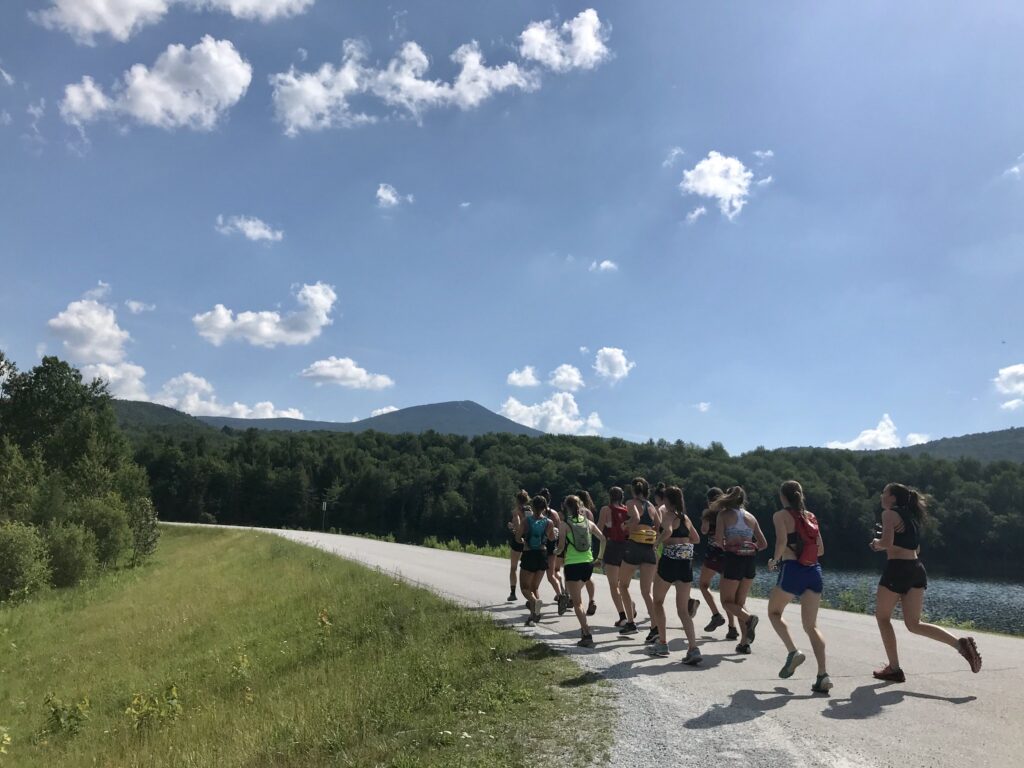
But the racing is carefully getting underway…we had a great timetrial at Pumpkin Harbor last weekend with 2 monster climbs, a gorgeous Vermont day, and sprawling mountains laid out in the sun. This week we will tackle the 3km on the track once again, and we have a prep workout at App Gap the end of the week as we look ahead to the App Gap Challenge in all its various forms this year.

It wasn’t the whole squad out there on Saturday, but we had 14 tough competitors line up for this timetrial between Cambridge and Fletcher. I have to give a big shoutout to all the coaches who helped…there were 5 leaders in all just to pull it off!

Lukas was the starter

Adam drove his car back and forth to capture video

Sara took times at a 5km split station

Rick waited at the one intersection with a bright vest to help be traffic monitor

Perry was at the finish recording times

Just goes to show how much can factor into even a small timetrial with a handfull of already-capable athletes. We have had more coaching support than EVER this summer for the Juniors and we could not have done it without this increase in dedicated, smart, ski-ready staff. So thanks to all these folks along with Charlie, Mike, Rosemary, Sam, Liam, Andy, Dana and more.

Juniors: 2 more things!

1)Please use the form below to submit your fall class schedule as we start to piece together what our own training schedule (times, locations, durations) will look like once school begins. Thank you!

MNC Fall Class Schedule

2) If you are interested in getting skis ground, please take a look at this page and reach out with any questions!


Social media & sharing icons powered by UltimatelySocial